
Molecular Clouds at the Galactic Edge: Turbulent, Active, but Gravitationally Unbound
The outskirts of the Milky Way, characterized by low metallicity, weak radiation fields, and sparse gas, serve as ideal laboratory for investigating how stars form under extreme conditions. Compared to the solar neighborhood, molecular clouds here are more widely distributions and diffuse, resembling stretched cotton. Due to diminished external perturbations such as spiral arm compression and supernova-driven shocks, star formation activity in these clouds is significantly reduced.
Limited by observational resolution, previous studies could only reveal the overall outlines of molecular clouds while failing to resolve their internal structures or accurately measure their masses, densities, and internal kinematics. Therefore, high-resolution observations of these molecular clouds are crucial for revealing how star formation in metal-poor environments.
Recently, a research team led by the Star Formation and Evolution Group at the Xinjiang Astronomical Observatory, Chinese Academy of Sciences, conducted observations on Galactic edge clouds located about 17 kiloparsecs (50,000 light-years) from the Galactic Center using the IRAM 30-meter telescope in Spain.The research team obtained CO (2-1) data with an angular resolution of approximately 11 arcseconds, allowing them to clearly resolve the internal clump structures within these molecular clouds. A systematic analysis of their physical properties and Larson’s relations was carried out.
The findings have been published in Astronomy & Astrophysics.
Based on statistical analyses of these molecular clumps, researchers found that: (1) significant turbulent motion exists within molecular clouds even in metal-poor environments, indicating their gas is not static but in a complex dynamical state; (2) the column densities of molecular clumps remain relatively constant, consistent with observations in the inner Galaxy; (3) most clumps are not yet fully gravitationally bound, although the degree of gravitational binding tends to increase gradually with distance from the Galactic Center.
Although the edge of the Milky Way is desolate, cold and lacks abundant matter, the molecular clouds are still active and follow similar physical laws to those within the inner Galaxy. However, due to the lack of sufficient gravitational force and metals, most of the clouds are in a "loose" state and are difficult to give rise to stars on a large scale like those within the inner Galaxy.
This study provides crucial observational evidence for understanding how molecular clouds evolve and how stars form in extreme environments.
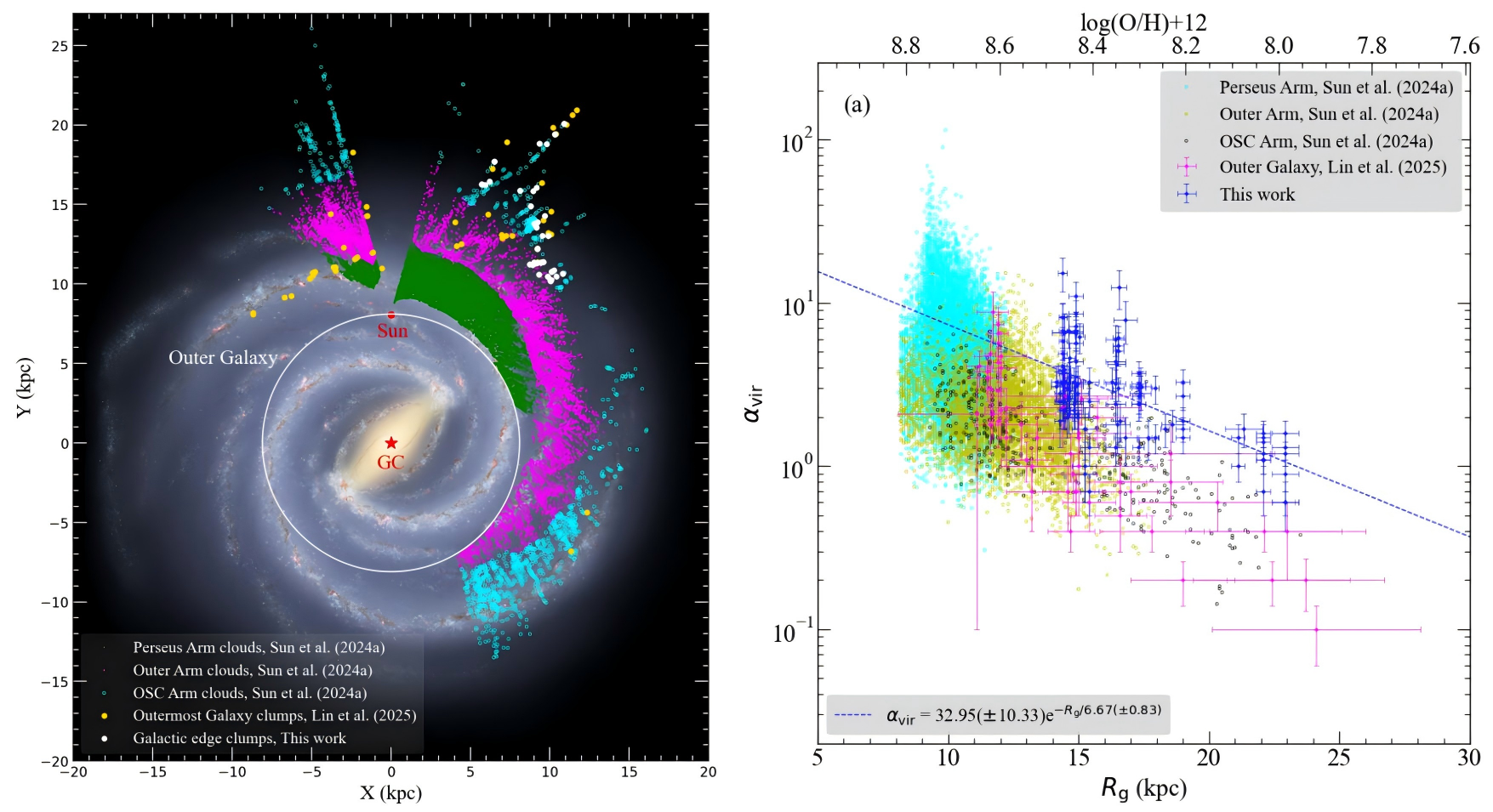
Left: Spatial distribution of molecular clouds (white circles) at Galactic edge. Right: Virial parameter as a function of Galactocentric distance.
Attachment Download:




