
Researchers discover a new candidate for an explosive molecular outflow
Explosive molecular outflows are a violent gas ejection phenomenon in massive star-forming regions, manifesting as large amounts of high-velocity gas streaming out from a common center in different directions, with velocities that tend to increase with distance from the eruption center.
At present, the sample of known explosive outflows remains very limited, and their formation mechanism is not yet fully understood. Discovering new candidate explosive outflows is of great significance for understanding the early dynamical evolution of massive stars and star clusters.
Recently, LUO Yongquan, a doctoral student in the Star formation and evolution group at the Xinjiang Astronomical Observatory of the Chinese Academy of Sciences, along with his supervisor, Prof. ZHOU Jianjun, and collaborators, used data from the ATOMS and QUARKS projects of the ALMA to conduct a multi-band observational study of the massive star-forming region IRAS 16119-5048 and discovered a relatively low-energy explosive outflow.
The related research results have been published in the international astronomy journal Monthly Notices of the Royal Astronomical Society (MNRAS, 2026, 551, 1–17).
Using CO (2-1) emission, the research team identified an explosive outflow candidate (as shown in Figure 1). This high-velocity outflow has a total mass of about 2.0 solar masses, a momentum of about 62.3 solar masses kilometers per second, and a kinetic energy of about 2.5×1046 erg, with a dynamical age of about 5,900 years. Its kinetic energy is at least an order of magnitude lower than that of most known explosive outflows. Further analysis indicates that feedback from the nearby H II region may compress and shape the surrounding molecular gas and influence the morphology and kinematics of the outflow.
In addition, the region contains 27 dense cores distributed along a filamentary structure, which may have been produced by thermal Jeans fragmentation or thermal cylindrical fragmentation. These dense cores exhibit a strong tendency toward mass segregation, with more massive dense cores concentrated near the explosion center, suggesting that dynamical interactions or close encounters among the dense cores near the explosion center may have contributed to triggering the explosive outflow.
This study provides a new candidate sample of explosive molecular outflows and offers new observational clues for understanding dynamical interactions in young massive star clusters and their feedback on the surrounding molecular gas.
This research was supported by the National Key Research and Development Program of China, the National Natural Science Foundation of China, the Natural Science Foundation of Xinjiang Uygur Autonomous Region, and other funding programmes.
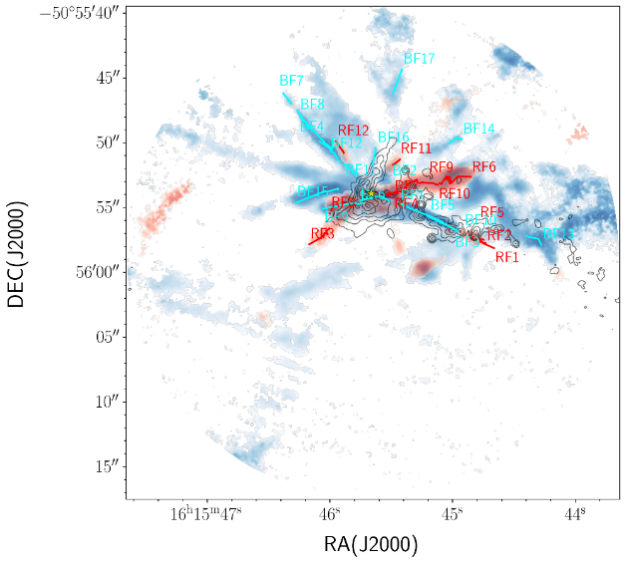
Figure 1. The color image shows the explosive molecular outflow traced by CO (2-1) (red and blue indicate redshifted and blueshifted emission relative to the systemic velocity), and the black contours show the dense dust structures traced by 1.3 mm continuum emission.
Attachment Download:




