
“Twin” Type Ia Supernovae Are Not Exactly Alike — Metallicity Differences May Affect Cosmic Distance Measurements
In the vast cosmos, supernova explosions are widely regraded as the most brilliant fireworks in the universe. Among them, Type Ia supernovae (SNe Ia) are hailed as “standard candles”due to their highly consistent peak luminosity which makes them a key tool for measuring cosmic distances. However, a recent study has found that even SNe Ia that appear almost like twins may hide small “genetic” differences that could affect the accuracy of distance measurements.
Dr. Abdusamatjan Iskandar from the Xinjiang Astronomical Observatory of the Chinese Academy of Sciences, in collaboration with researchers from Tsinghua University and other domestic and international research institutes,conducted a systematic analysis of SN 2021pfs, a SN Ia that exploded in June 2021 in the galaxy NGC 5427, using observational data obtained from the Las Cumbres Observatory global telescope network. The researchers carried out a detailed study of its light and spectra, from optical brightness measurements to spectral analysis.
The results were published in Science China: Physics, Mechanics & Astronomy, 2026, Vol. 69, No. 9: 299511.
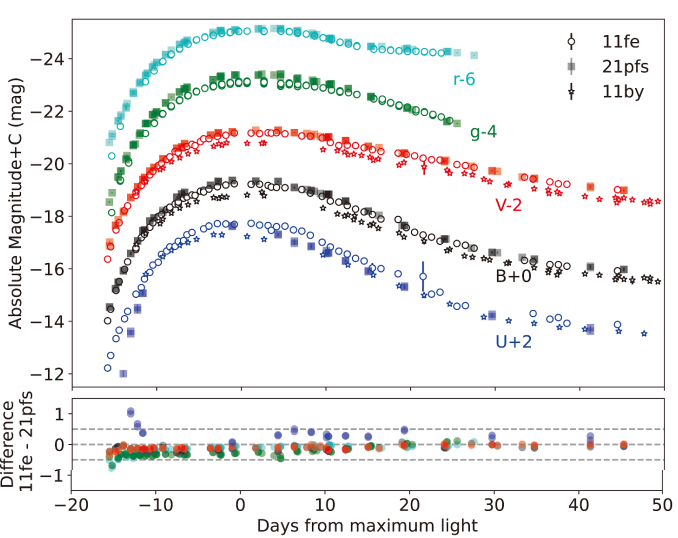
The researchers found that this supernova is very similar to the famous SN Ia SN 2011fe from a decade ago. The B-band light curve width and peak absolute luminosity, and the way the spectra changed over time all looked almost the same.
Hoever,through more detailed comparison, slight differences appeared. SN 2021pfs brightened faster in blue and violet light, and its peak brightness in the “bolometric” light curve — a measure of total energy output — was slightly dimmer than that of SN 2011fe. It also produced a bit less radioactive nickel, which is the key energy source that powers a supernova’s glow.
By analyzing the environment in its host galaxy, the researchers found that SN 2021pfs was born in a region with higher metal content. This small difference in “family background” — a higher metallicity in the progenitor star — may explain the slight difference in its light curve from that of SN 2011fe.
By comparing this pair of nearly “twin” type SNe Ia, the study reveals that metallicity is a hidden factor that can affect the consistency of SNe Ia. It shows that scientists need to explore the complex and subtle physics behind the diversity of SNe Ia. This will help improve future cosmic distance measurements and make them more accurate.
The research was supported by the Natural Science Foundation of Xinjiang Uygur Autonomous Region and other projects.
Attachment Download:





