
Are Magnetar Magnetic Fields “Twisted”? X-ray Polarization Observations Offer New Clues
Are the large-scale magnetic fields of magnetars dominated by a dipolar structure, or is a significant magnetic-field twist required to explain the observations? A recent study from the Xinjiang Astronomical Observatory (XAO) of the Chinese Academy of Sciences has provided new clues.
Magnetars are neutron stars with ultrastrong magnetic fields. Their magnetic fields are far stronger than those of ordinary neutron stars, making them important natural laboratories for studying strong-field physics in the universe. As a magnetar rotates, the projected direction of its magnetic axis changes on the sky, causing the observed X-ray polarization position angle to vary systematically with rotational phase. Phase-resolved polarimetric observations therefore provide important information for probing the radiation geometry and magnetic-field configuration of magnetars.
Dr. LI Biaopeng of the Pulsar Research Group at XAO, along with his supervisor Prof. GAO Zhifu, used phase-resolved polarimetric data from the Imaging X-ray Polarimetry Explorer (IXPE) to carry out a uniform Bayesian analysis of the radiation geometries of the magnetars 1E 2259+586 and 1E 1547.0−5408. In simple terms, Bayesian analysis uses observational data to update the credibility of different models and quantitatively assess which model is better supported by the data.
The study found that the current X-ray polarization position-angle variations of both magnetars can be adequately explained by geometrical models dominated by large-scale dipolar magnetic fields, without requiring a significant global magnetic-field twist. The results were published in The Astrophysical Journal (1008:40, 2026).
The researchers compared two magnetars with markedly different polarization properties. 1E 2259+586 shows relatively weak phase-averaged X-ray polarization, whereas 1E 1547.0−5408 exhibits a higher polarization degree and a clear variation in polarization position angle. The analysis employed both the classical rotating vector model and a modified model that includes a first-order magnetic-field twist correction, and compared the two models using Bayesian evidence and information criteria. For 1E 2259+586, the twist-corrected model provides a somewhat better fit, but the statistical evidence is insufficient to establish a significant global twist. For 1E 1547.0−5408, the two models provide broadly comparable fits, and the classical dipole-dominated geometrical model is already able to describe its X-ray polarization position-angle variation well.
This study establishes a uniform Bayesian model-comparison framework for using X-ray polarization position angles to constrain magnetar radiation geometry and to test the extent to which their large-scale magnetic fields depart from a dipolar configuration. Future X-ray polarimetric observations with higher sensitivity, together with multiepoch data, will help place tighter constraints on magnetar magnetic-field geometry.
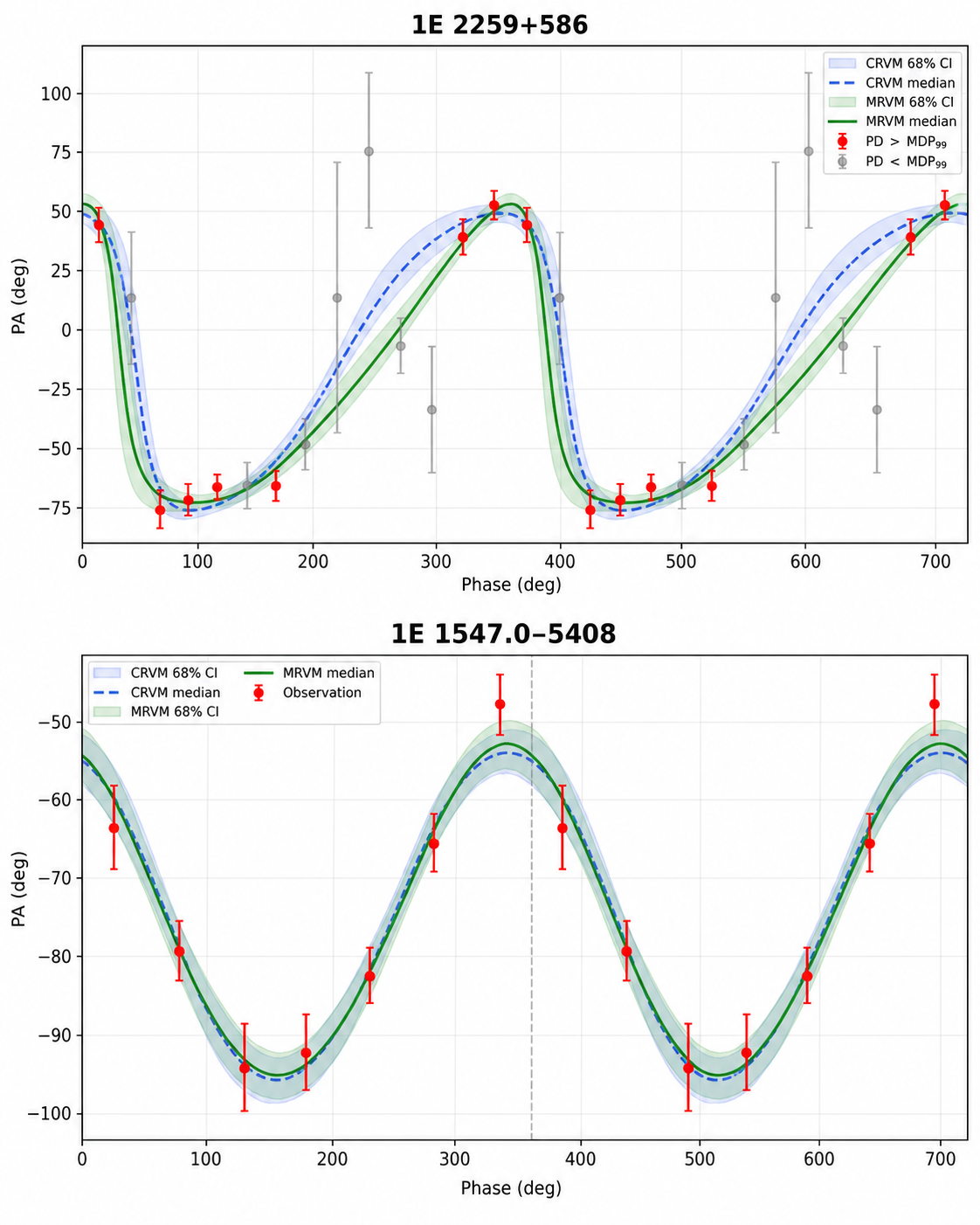
Phase-resolved X-ray polarization position angles and their posterior predictive distributions for the two magnetars.
The upper panel shows magnetar 1E 2259+586, and the lower panel shows magnetar 1E 1547.0−5408. The blue dashed curves and light-blue shaded regions represent the posterior medians and 68% credible intervals of the classical rotating vector model (CRVM), respectively, while the green solid curves and light-green shaded regions represent the posterior medians and 68% credible intervals of the modified rotating vector model (MRVM) including a first-order magnetic-field twist correction. The red data points show the IXPE polarization measurements. For 1E 2259+586, the gray data points correspond to phase bins in which the polarization degree is below the minimum detectable polarization at the 99% confidence level (MDP₉₉); these points were not included in the geometrical model fitting.
Attachment Download:





