
Researchers Reveal the First Jet Collimation Profile in an X-ray Binary
Active galactic nuclei (AGN), powered by accreting supermassive black holes, and X-ray binaries (XRBs), powered by accreting neutron stars or stellar-mass black holes, are two representative classes of compact accreting systems (Figure 1). Relativistic collimated jets are among the most spectacular phenomena in these systems. Understanding how these powerful outflows are launched, accelerated, and collimated is one of the major questions in modern astrophysics. In terms of jet collimation, this aspect has been extensively studied in AGN, however, the jet collimation profiles in XRBs remain unknown.
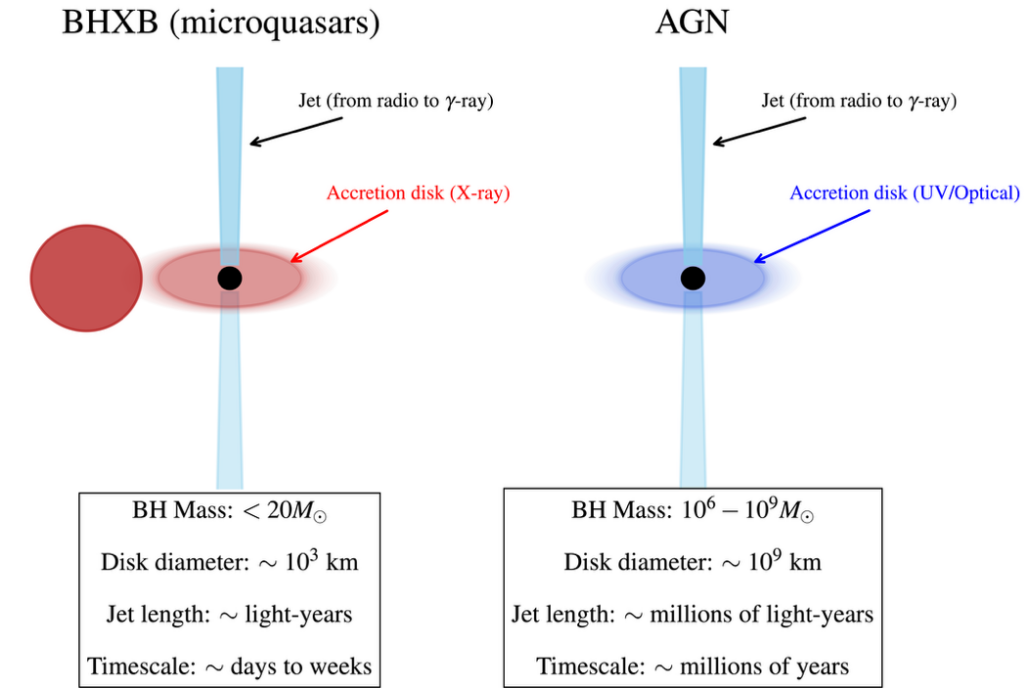
Figure 1. Comparison of the fundamental parameters of black hole X-ray binaries (BHXBs; microquasars) and active galactic nuclei (AGN).
Several factors have contributed to this observational gap: (1) the short evolutionary timescales of XRBs result in rapidly change in jet morphologies; (2) the transient nature of XRBs makes it difficult to obtain high-quality Very Long Baseline Interferometry (VLBI) observations at the appropriate times, resulting in a lack of high-quality multi-frequency VLBI data; (3) XRBs are generally located close to the Galactic plane, where interstellar scattering can severely affect VLBI observations; and (4) multi-frequency VLBI measurements of core shifts, which are essential for determining the distance scale along the jet, have been lacking.
Recently, Dr. YAN Xi, a postdoctoral researcher from the galaxy and cosmology research group/ VLBI research group at the Xinjiang Astronomical Observatory (XAO) of the Chinese Academy of Sciences, with his supervisor Prof. CUI Lang, and their international collaborators, conducted an in-depth analysis of archival VLBI data of the famous X-ray binary SS 433. By measuring the jet width as a function of distance from the central black hole, they, for the first time, obtained the jet collimation profile in an X-ray binary, representing an important step toward revealing the physical mechanisms governing jet collimation in stellar-mass accreting systems. The results have been published in The Astrophysical Journal Letters, a leading international astronomy journal (Yan et al. 2026b, ApJL, 1007, L49).
As shown in Figure 2, the 1995 and 1998 data reveal that both the approaching and receding jets of SS 433 exhibit quasi-parabolic collimation profiles. However, observations obtained in 2000 tentatively suggest a different jet collimation behavior. The researchers found that the widths of both jets show a transition from a relatively flat to a steeper trend (Figure 3). Combined with observations from 1999, these results suggest that the collimation behavior of SS 433 may itself be diverse, with the intrinsic collimation profile potentially differing substantially between different activity periods.
Notably, such diversity in jet collimation would be extremely difficult to observe within a single AGN. Because AGN evolve on timescales of millions of years or longer, it is impossible to monitor the evolution of an individual AGN jet collimation profile over a human lifetime. In contrast, XRBs evolve on timescales ranging from days to weeks, providing an excellent laboratory for monitoring the evolution of jet collimation.
In the future, XRBs may therefore offer unique opportunities to reveal a wide variety of jet morphologies and collimation behaviors. In addition to the collimation profile, the researchers also obtained the first core-shift relation for an XRB using multi-frequency observations of SS 433. The measured relation is broadly consistent with theoretical expectations and measurements from nearby AGN.The core-shift measurements and jet collimation profiles of SS 433 have, for the first time, brought together the studies of the nuclear environments and jet collimation physics of XRBs and AGN, establishing an important foundation for future investigations into the formation, propagation, and evolution of jets in these two classes of accreting systems.
It is worth noting that the research team has been actively investigating the accretion-jet coupling and jet physics of XRBs through multi-wavelength observations, including recent work on GRS 1915+105 (see the report: Discovery of Unusual Jet Orientation Variations in the Microquasar GRS 1915+105). The team has also long been dedicated to high-resolution VLBI studies of AGN jets (see the related report). By systematically comparing the similarities and differences in jet physics between these two classes of accreting systems, the team aims to develop a more comprehensive understanding of the universal physical processes governing jet formation and evolution across vastly different cosmic scales.
This research was supported by the China Postdoctoral Science Foundation, the National Natural Science Foundation of China, and the National Key Research and Development Program of China.
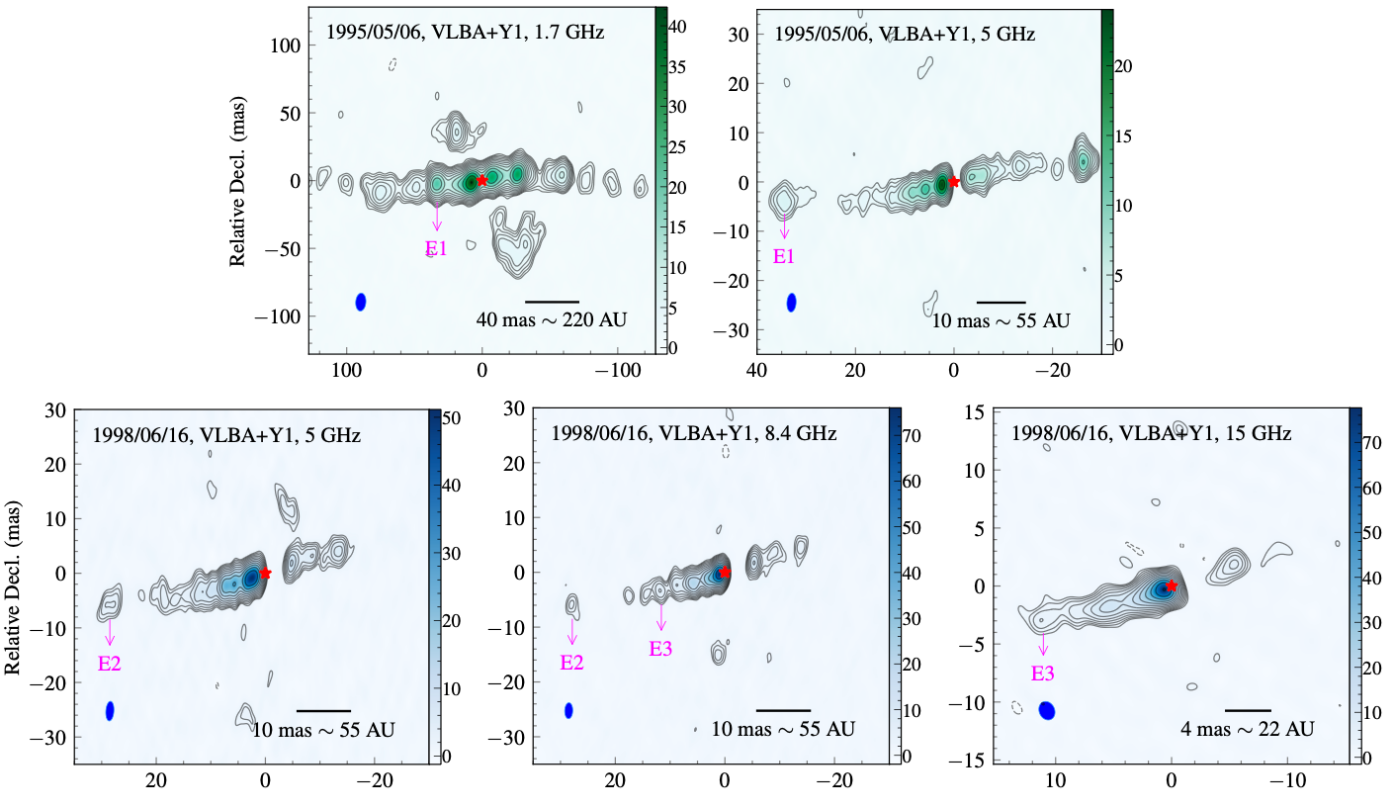
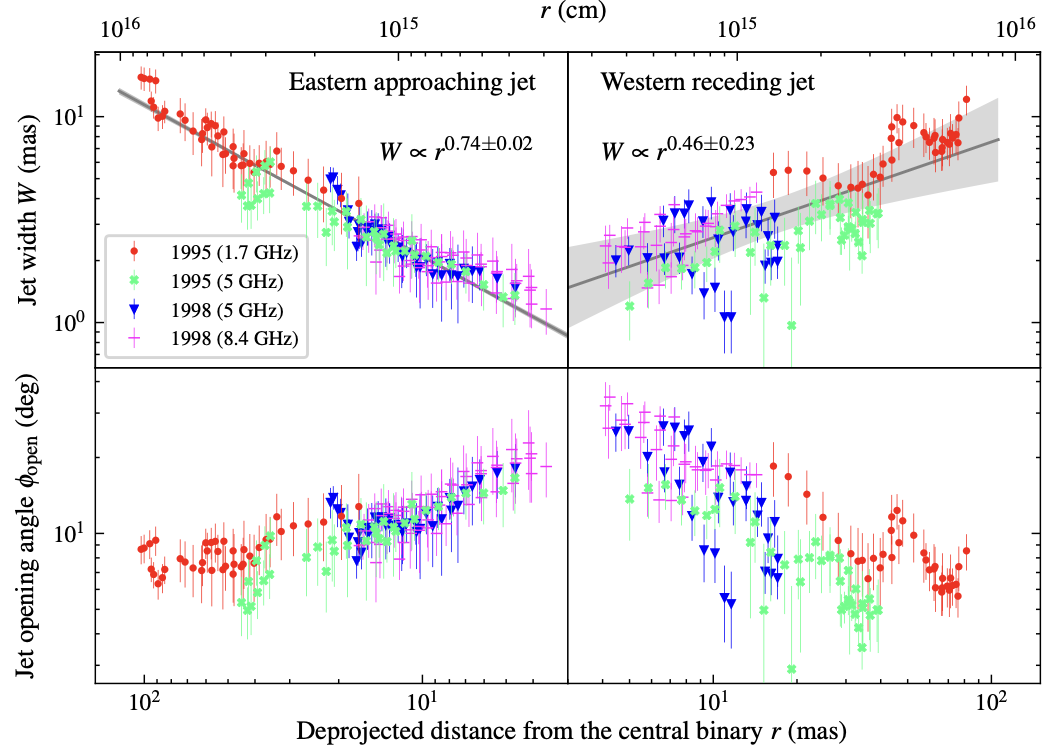
Figure 2. Top: Multi-frequency VLBI images of SS 433 obtained in 1995 and 1998. Bottom: The evolution of the jet width (top) and opening angle (bottom) as a function of distance from the central binary. The evolution of the jet width, w, with distance, r, from the central binary (i.e., the collimation profile) can be described as w ∝ra, where a=0,0.5, and 1 correspond to cylindrical, parabolic, and conical profiles, respectively. The 1995 and 1998 observations indicate that both the approaching and receding jets of SS 433 exhibit quasi-parabolic collimation profiles.
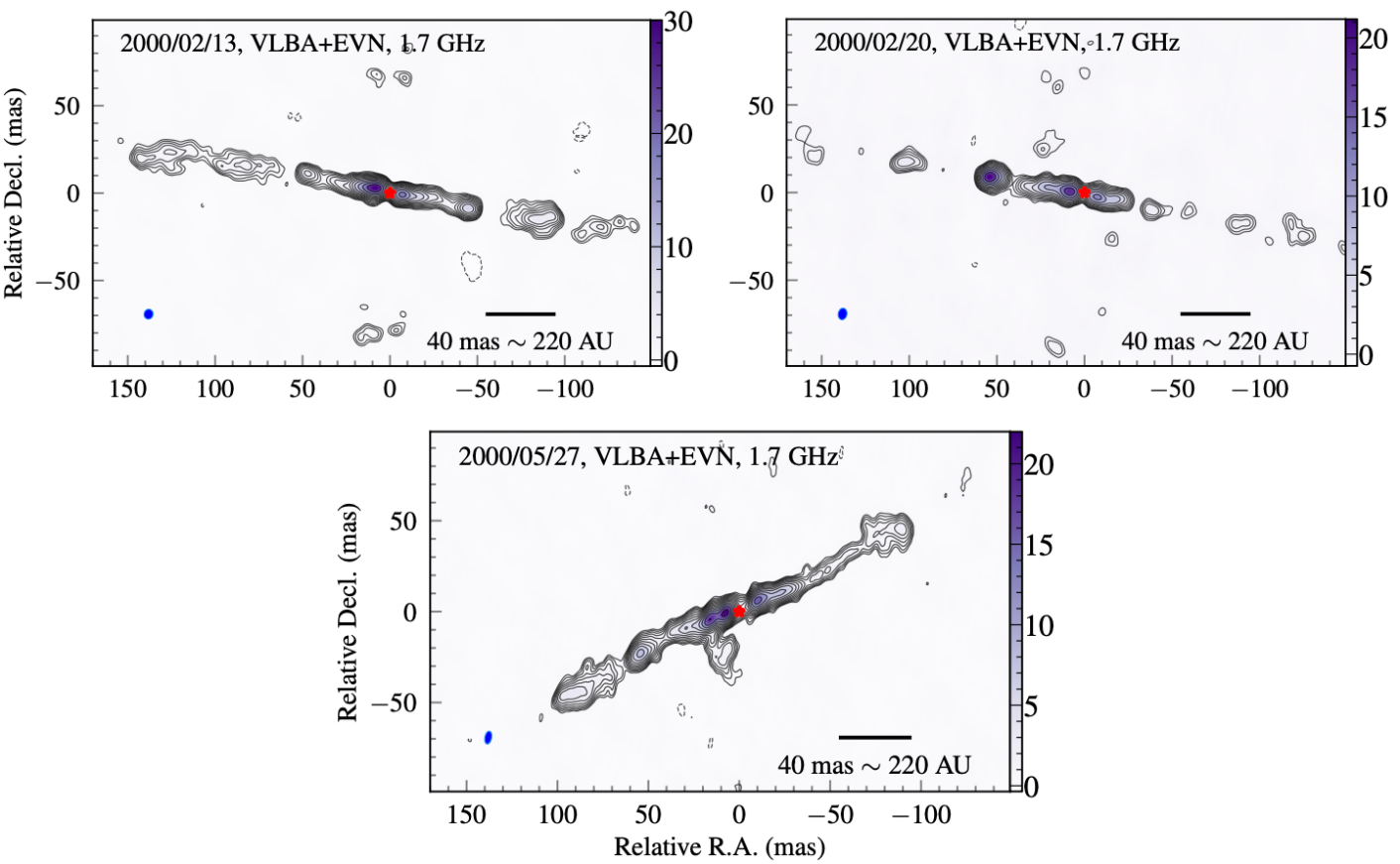
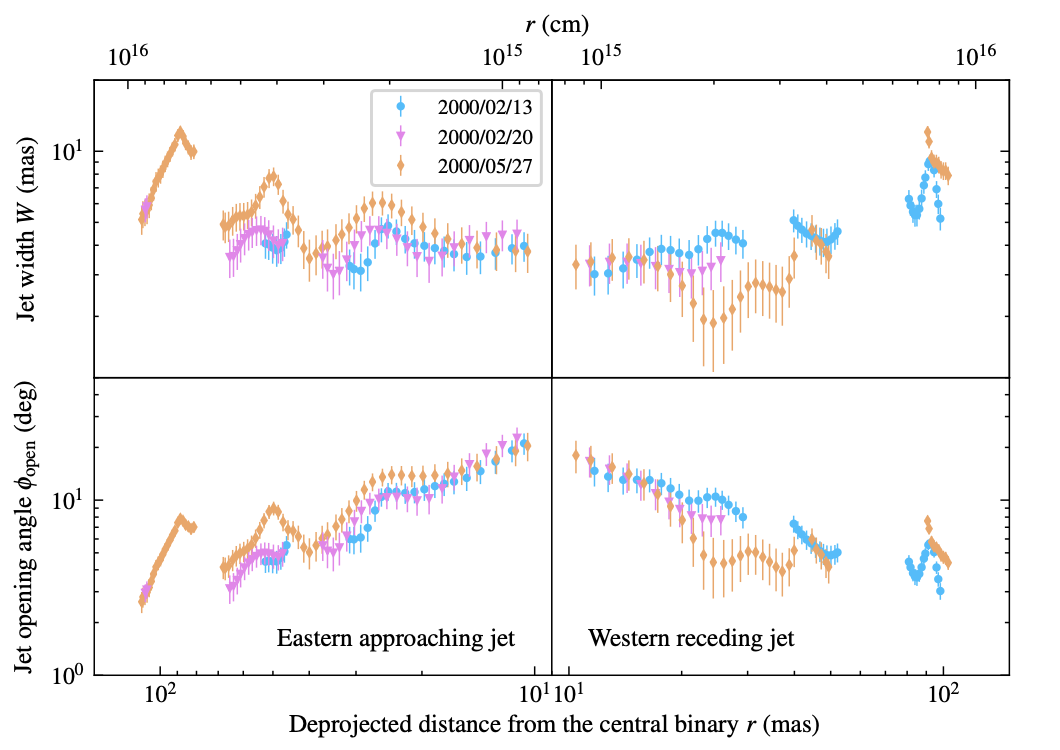
Figure 3. Top: Multi-epoch 1.7 GHz VLBI images of SS 433 obtained in 2000. Bottom: The evolution of the jet width (top) and opening angle (bottom) as a function of distance from the central binary. The widths of both the approaching and receding jets exhibit a transition from a relatively flat to a steeper trend, indicating a change in the jet collimation profile.

Figure 4. Schematic illustration of the jet width profiles of SS,433 (AI-generated).
Attachment Download:




