
Spectroscopic Confirmation of Contact Binary Candidates Enabled by Multi‑Survey Data
A research team led by Ph.D. student WU Ting, together with her supervisor prof. LIU Jinzhongfrom Xinjiang Astronomical Observatory and Prof. GU Weimin from Xiamen University, has developed a new method for identifying contact binary candidates based on photometric periods, stellar radii, and radial velocity variations.
By combining high-precision photometric data from the Transiting Exoplanet Survey Satellite (TESS), medium-resolution spectroscopic data from the Large Sky Area Multi-Object Fiber Spectroscopic Telescope (LAMOST), and stellar parameters from Gaia Data Release 3 (Gaia DR3), they identified 1,281 contact binary candidates, including 266 newly discovered candidates. The results have been published in The Astrophysical Journal Supplement Series.
Contact binaries are an important class of close binary systems in which both stars fill their Roche lobes and share a common outer envelope. These systems undergo significant exchanges of mass and energy, making them valuable laboratories for studying stellar evolution processes, including mass transfer, tidal interactions, angular momentum loss, and stellar mergers.
In this study, the researchers cross-matched the TESS sources with the LAMOST DR11 spectroscopic catalog, and incorporated Gaia DR3 data to obtain fundamental stellar properties. They analyzed multi-epoch LAMOST spectra to identify targets with significant radial velocity variations and applied Roche-lobe geometry constraints to establish period–radius criteria for selecting potential contact or near-contact binary systems. Statistical analysis shows that the newly identified candidates exhibit distributions consistent with known contact binaries in both the period–radius diagram and the color–magnitude diagram.
To further verify their binary nature, the team performed cross-correlation function analysis and spectral decomposition on the LAMOST medium-resolution spectra. Among the 266 newly discovered candidates, 246 display spectroscopic binary features, corresponding to approximately 92%, providing strong evidence for their binary nature. For 166 targets with high-quality radial velocity measurements, the researchers further modeled radial velocity curves and derived important orbital and physical parameters, including velocity semi-amplitudes, mass ratios, and mass functions.
This work demonstrates the complementary advantages of combining multi-survey astronomical data from TESS, LAMOST, and Gaia. It not only significantly expands the sample of contact binary candidates but also provides an effective framework for large-scale searches, spectroscopic confirmation, and physical parameter determination of contact binary systems.
The research was supported by the National Natural Science Foundation of China and other funding programs.
Publication link::https://iopscience.iop.org/article/10.3847/1538-4365/ae5958
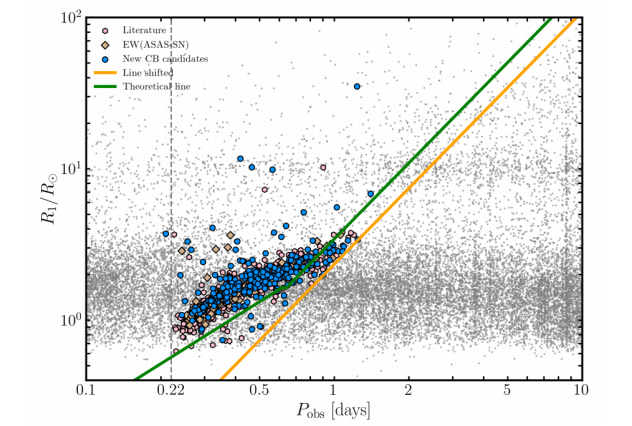
Figure 1. Distribution of photometric period versus radius for contact binary candidates.
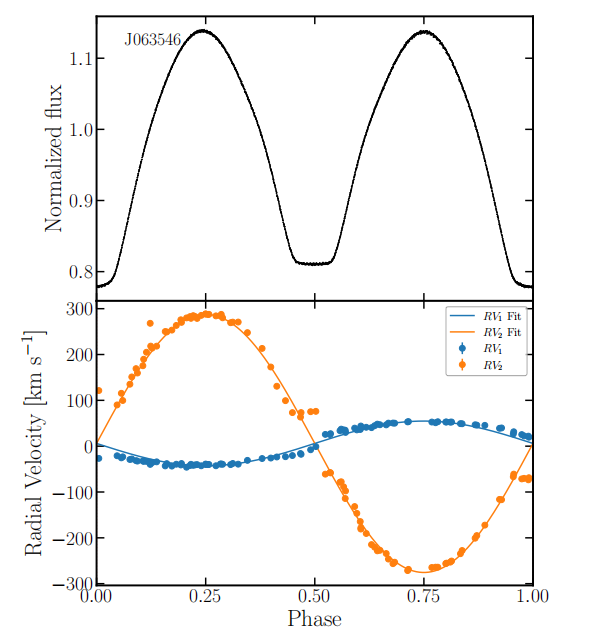
Figure 2. Phase-folded light curve (top) and radial velocity curve (bottom) of the contact binary candidate J063546. The solid line represents the best-fitting Keplerian orbital model
Attachment Download:





