
A Gaze Through the Dust: A Hidden Black Hole Uncovered in a Rare Triple-Galaxy Collision
Galaxy mergers are among the most spectacular and destructive events in the Universe. During these encounters, not only billions of stars are redistributed, but the supermassive black holes lurking in the galaxies' centers can also interact with one another. Systems in which three galaxies are merging simultaneously, however, are quite rare.
Recently, XU Wancheng , a Ph.D. student at the Xinjiang Astronomical Observatory (XAO) — currently a visiting researcher supported by the China Scholarship Council at the Konkoly Observatory in Hungary — under the supervision of Dr. Sándor Frey and Prof. Lang Cui, obtained the first direct observational evidence for an active galactic nucleus (AGN) in the triple-merger galaxy UGC 2369S.
The study reveals that deep within the northern nucleus of this complex system lurks a supermassive black hole steadily accreting matter from its surroundings. The results have been published in the prestigious international astronomical journal Astronomy & Astrophysics.
UGC 2369S is a triple-merger luminous infrared galaxy located about 450 million light-years from Earth. The system is rich in interstellar gas and dust, and these thick clouds heavily obscure the central regions, effectively "blinding" conventional optical observations. To overcome this limitation, the researchers turned to radio astronomy, employing the technique of Very Long Baseline Interferometry (VLBI), which combines observations from radio telescopes separated by up to thousands of kilometers across the Earth to achieve extremely high angular resolution.
Drawing on archival data from the European VLBI Network (EVN) and the U.S. Very Long Baseline Array (VLBA), the researchers mapped the galactic nuclei in the system with milliarcsecond resolution.
By analyzing the L- and C-band VLBI datasets obtained during 1996 and 2003, which were never fully analyzed or published, the researchers uncovered a compact radio source associated with the northern nucleus of UGC 2369S. Its distinctive physical properties clearly indicate that the emission originates not from extended star formation, but from a genuine AGN.
Perhaps the most intriguing result is that this AGN, despite its relatively modest power output, launches relativistic plasma jets. Its central black hole is enshrouded by a very dense cocoon of gas and dust, rendering it almost invisible at optical wavelengths. Radio waves, however, penetrate this obscuring material, allowing the VLBI observations to identify the hidden nucleus directly.
The analyzed results also suggest that the black hole is currently accreting matter at a relatively low rate while simultaneously injecting a substantial amount of energy back into its galactic environment through its radio-emitting jets.
These findings have implications that extend well beyond this single system. Galaxy mergers are a fundamental driver of cosmic evolution, shaping both the growth of supermassive black holes and the history of star formation in galaxies. UGC 2369S demonstrates that even the most heavily obscured galactic nuclei can host active black holes that remain virtually undetectable by means of conventional optical observations. VLBI provides one of the most powerful tools available for uncovering these hidden, jet-producing black holes.
Article link: https://doi.org/10.1051/0004-6361/202660763
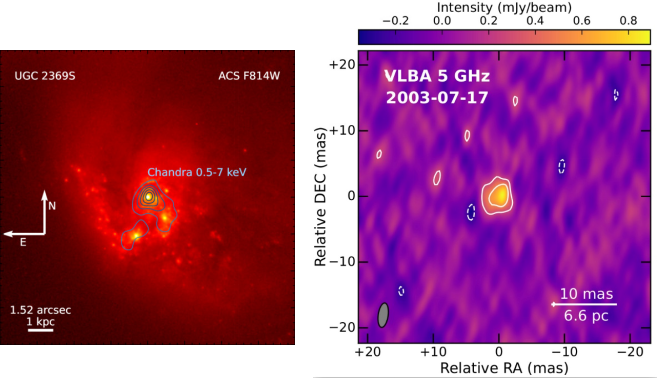
Figure 1: Left panel: The merging triple-galaxy system UGC 2369S as observed in the near infrared with the Advanced Camera for Surveys (ACS) aboard the Hubble Space Telescope (Credit: Y. Ding et al., 2026). The overlaid contours show the X-ray intensity measured by the Chandra X-ray Observatory in the 0.5–7 keV energy range. The scale bar in the lower left corresponds to approximately 3,300 light-years. The compact radio source detected with VLBI is located within the northern galactic nucleus, which is also the brightest in X-rays. Right panels: The highest-resolution VLBI image of the northern nucleus of UGC 2369S, obtained with the VLBA at 5 GHz (Credit: W. Xu et al., 2026). The white bar in the lower right corresponds to 10 milliarcseconds, equivalent to only 21.5 light-years at the distance of the galaxy. In other words, this image zooms in by roughly a factor of 150 compared with the left figure.
Attachment Download:




