
What is the pulsar radio emission region like in general?
For more than 50 years, pulsar scientists have tried to understand how the place, where radio emission is generated, looks like. Some suggest that the emission region is uniform and well-organised, whereas others think that it is random and patchy.
An essential distinction between the two suggestions is that the uniform model implies a region being constituted entirely by the open magnetic field lines, known as the open-field region. The emission "obeys" a well-defined geometry, in which the visibility of a radio pulsar is predictable.
Using four long period pulsars discovered by the Five- hundred-meter Aperture Spherical radio Telescope (FAST), Prof. RAI Yuen from Xinjiang Astronomical Observatory, Chinese Academy of Sciences, has investigated radio emission by comparing the profile widths predicted by the emission geometry with observed ones.
As shown in the figure, hefound thatthe observable emission regions tend to coincide with the open-field regions, and their centres also exhibit a tendency to align, as the rotation period increases. This means that the emission originates around the magnetic pole.
The results demonstrate that the emission structure is likely uniform in the open-field region at large rotation period. For pulsars with long rotation periods, the emission likely comes from the whole open-field region, consistent with the standard emission geometry.
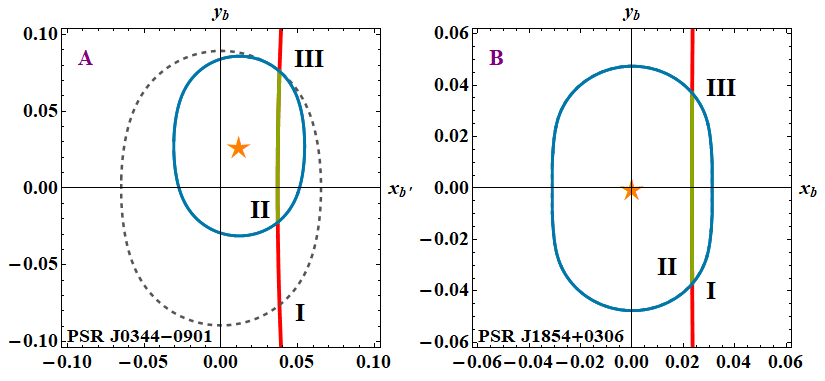
Figure: Plot showing the observable emission coming from the green part along the sightline path (red) within the open-field region in the magnetic frame. The two pulsars possess rotation periods of 1.23 s (left) and 4.557 s (right). The boundaries for the open-field regions and the actual observable emission region are indicated in dotted black and solid blue, respectively. The open-field region is centered at the origin, and the centre of the observable emission region is indicated by a star symbol in orange in each plot.
Attachment Download:





