
Installing a “Filter” for FAST: Researchers Develop an Automatic Multi-Beam RFI Mitigation Tool
Under the starry night sky, radio telescopes serve as humanity’s sensitive “ears,” capturing faint whispers from the depths of the Universe. However, with the rapid expansion of modern communication technologies, radio frequency interference (RFI) generated by human activities has become increasingly pervasive, posing a serious challenge to astronomical observations.
Recently, PhD candidate BAI Juntao from the Pulsar Research Group at the Xinjiang Astronomical Observatory (XAO), Chinese Academy of Sciences (CAS), guidedby his supervisors, Prof. WANG Na of XAO and Prof. DAI Shi of Australia’s Commonwealth Scientific and Industrial Research Organisation (CSIRO), co-developed a high-efficiency RFI mitigation software package—mRAID(multi-beam RAdio-frequency Interference Detector)—specifically designed for multi-beam receivers. The tool significantly improves the search efficiency for pulsars and fast radio bursts (FRBs).
Researchers from the Xinjiang Astronomical Observatory(XAO) of the Chinese Academy of Sciences and collaborating institutions took a novel approach. By leveraging the mathematical principle of eigenvalue decomposition, they developed a high-efficiency RFI mitigation software package—mRAID(multi-beam RAdio-frequency Interference Detector)—specifically designed for multi-beam receivers. The tool significantly improves the search efficiency for pulsars and fast radio bursts (FRBs).
The signals detected by radio telescopes are extraordinarily faint and are often overwhelmed by terrestrial radio emissions such as mobile communications, satellite navigation systems, and radar signals. This challenge is particularly acute for large facilities like the Five-hundred-meter Aperture Spherical Radio Telescope (FAST), which is equipped with 19 beams receivers—effectively 19 “eyes” observing the sky simultaneously—and produces an enormous volume of data every second.
Traditional RFI mitigation methods are either insufficiently sensitive, missing weak interference, or computationally too slow to keep pace with real-time data acquisition. Identifying and removing these “disguised contaminants” accurately and efficiently from massive datasets has become a major bottleneck in time-domain astronomy.
PhD candidate BAI Juntao from the Pulsar Research Group at the Xinjiang Astronomical Observatory (XAO), Chinese Academy of Sciences (CAS), under the guidance of his supervisors, Prof. WANG Na and Prof. DAI Shi of Australia’s Commonwealth Scientific and Industrial Research Organisation (CSIRO), co-developed the software package named mRAID.The key innovation of this work lies in exploiting the spatial correlation inherent in multi-beam observations. Genuine astrophysical signals, such as pulsar emissions, typically appear in only one beam, whereas artificial interference (for example, from satellites) is often detected simultaneously across multiple beams. By constructing cross-correlation matrices from multi-beam data and performing eigenvalue decomposition, mRAID can effectively separate interference components from background noise—much like isolating impurities from a mixture—based on their shared statistical characteristics.
Tests on real FAST observational data demonstrate that mRAID delivers outstanding performance. Compared with rfifind in the widely used PRESTO pulsar search software suite, mRAID more effectively identifies short-timescale transient interference and substantially reduces the false-alarm rate of pulsar candidates.
Importantly, mRAID adopts a fully parallelized architecture, enabling high-speed processing on high-performance computing clusters. This capability provides essential technical preparation for large-scale survey observations with next-generation facilities, such as the QiTai radio Telescope (QTT). The software package has been released as open-source and is now available to the global astronomical community.
The research results were published in the international journal Publications of the Astronomical Society of Australia (PASA).Article link: https://doi.org/10.1017/pasa.2025.10139.
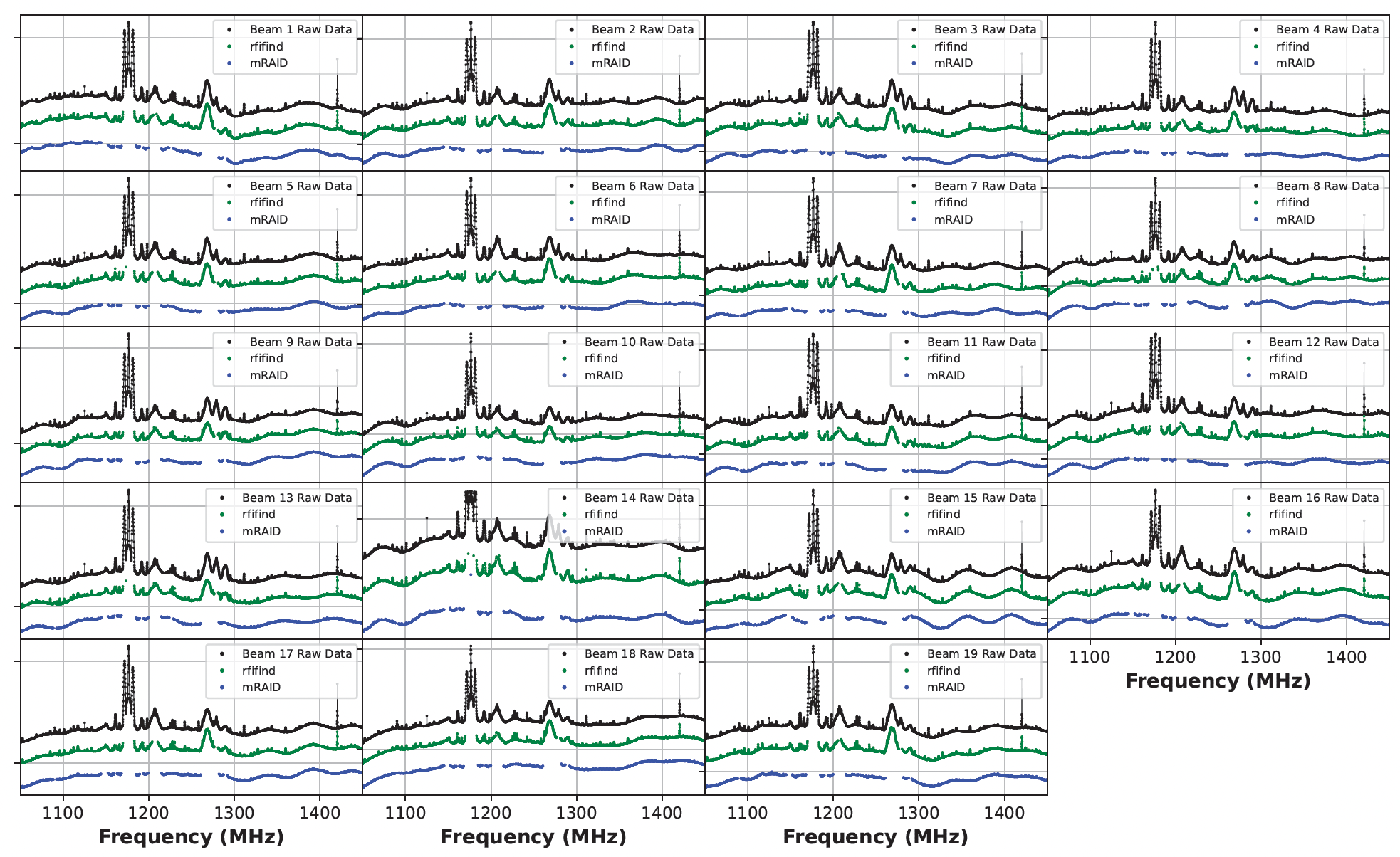
Figure 1. Comparison of RFI identification results between mRAID and rfifind for FAST 19-beam data.
Attachment Download:





