
Unveiling the Long-Term Evolution of Magnetar Swift J1834.9-0846
Recently, LI Biaopeng, a PhD student supervised by Prof. GAO Zhifu in the Pulsar Research Group at Xinjiang Astronomical Observatory, Chinese Academy of Sciences, carried out a study on the unusual spin-down behavior of the magnetar Swift J1834.9-0846.
The researchers developed a unified evolutionary model that simultaneously incorporates magnetic dipole radiation, wind braking, and gravitational-wave emission, and provided a new explanation for its unusually low braking index. The results were published in The Astrophysical Journal.
Magnetars are a class of celestial objects with extremely strong magnetic fields. The braking index of Swift J1834.9-0846 is significantly lower than the value predicted by the classical magnetic dipole radiation model, indicating that more complex physical processes may be involved in its spin-down evolution. At the same time, observations have revealed an extended nebula-like emission structure surrounding this magnetar, suggesting that high-energy particles continuously flowing out from the magnetosphere may play an important role in its long-term evolution.
The study has yielded a series of key findings. First, the high-energy particle wind from the magnetar contributes about 17%–51% of the present braking torque, comparable to the contribution from magnetic dipole radiation. Second, the results suggest that the star may host an internal magnetic-field configuration dominated by a toroidal component, which would explain the exceptionally low braking index. In addition, the study constrains the viscous dissipation parameter inside the star and indicates that its current gravitational-wave signal is too weak to be detected. However, at the very early stage after birth, under extremely optimistic conditions, the signal might have approached the sensitivity threshold of next-generation detectors.
The overall innovation of this work lies in establishing a new framework that connects magnetar spin evolution, internal physics, and multimessenger observations. This framework provides a physically self-consistent explanation for Swift J1834.9-0846 and also offers a new analytical tool for investigating other extreme neutron stars with similar properties.
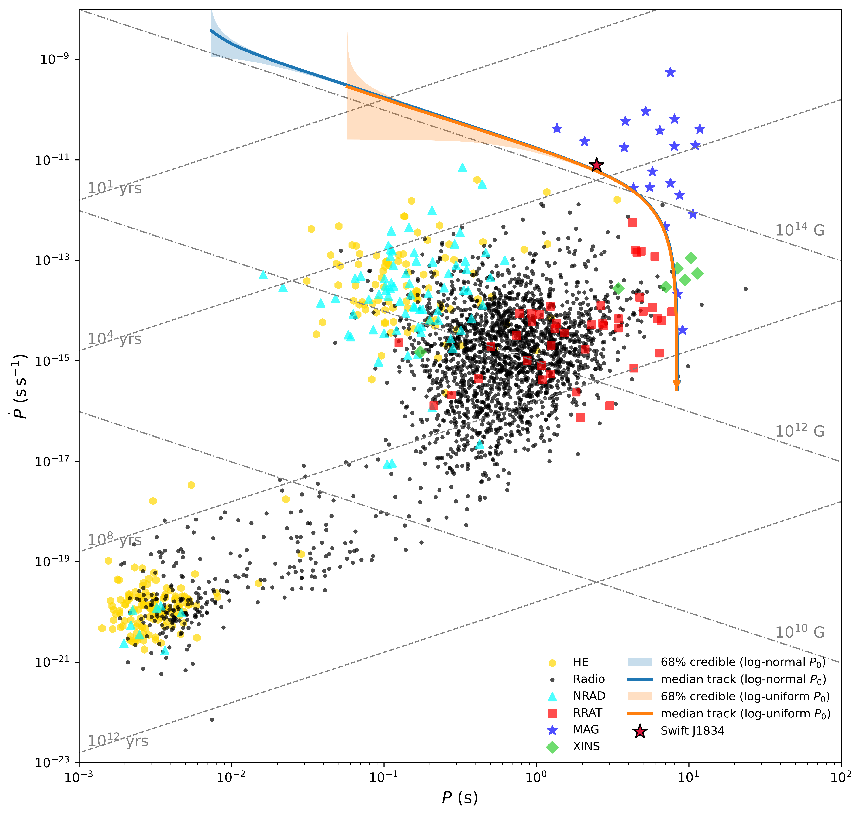
Evolutionary track of Swift J1834.9-0846 in the period-period derivative diagram.
Attachment Download:




