
Large-sample survey finds supersonic non-thermal motions common in Galactic cold-clump gas
Accurately determining the initial conditions of star formation is one of the necessary conditions for understanding star formation. This requires systematic study of cold molecular clumps that are in an extremely early evolutionary stage, have no ongoing star formation activity, and are therefore unaffected by feedback. In its all-sky survey in the submillimeter band, the Planck satellite discovered 13,188 cold molecular clumps. These provide an excellent sample for studying and determining the initial conditions of star formation.
Recently, YANG Yuebin, a doctoral student in the Star Formation and Evolution Group at the Xinjiang Astronomical Observatory (XAO), under the supervision of Professor Jarken Esimbek, used the Korean TRAO 14-meter telescope to observe the 12CO and 13CO (J=1–0) spectral lines of 2,008 Planck cold clumps (see Figure 1), obtaining their physical and kinematic properties. The related results were published in the The Astronomical Journal(172:146,2026).
Analysis shows that 12CO was detected in all 2,008 Planck cold clumps, while 13CO was detected in 1,895 of them. The line-center velocities of the two spectral lines are basically consistent, indicating that they trace kinematically related gas along the same line of sight. The average 13CO optical depth is about 0.5, and the average molecular hydrogen column density derived from 13CO is about 4.3×10²¹ cm⁻². The correlation between the molecular hydrogen column density derived from dust and the 13CO column density is also tighter than its correlation with the 12CO integrated intensity. The average excitation temperature of the clumps is about 10 K.
The study also finds that the Mach number of the gas traced by 13CO has an average value of 4.3 and a median of 3.6, indicating that supersonic non-thermal motions are ubiquitous in the sample. The CO–H₂ conversion factor increases with the molecular hydrogen column density derived from dust and tends to be higher in colder clumps. These statistical trends obtained from a large sample are consistent with the explanation that in low-temperature, high-density environments, CO may freeze out from the gas phase and attach to the surfaces of dust grains. Overall, although the cold clumps in the Milky Way have low temperatures, their gas motions are generally active.
This study, based on a large sample, reveals the ubiquitous non-thermal motion characteristics of the gas in Planck cold clumps, further strengthens the constraints on the initial conditions of star formation, and also provides a very good sample for future in-depth research.
This research was supported by the National Key Research and Development Program of China, the National Natural Science Foundation of China, the Natural Science Foundation of Xinjiang Uygur Autonomous Region, and other funded projects.
Paper link: 10.3847/1538-3881/ae8cff
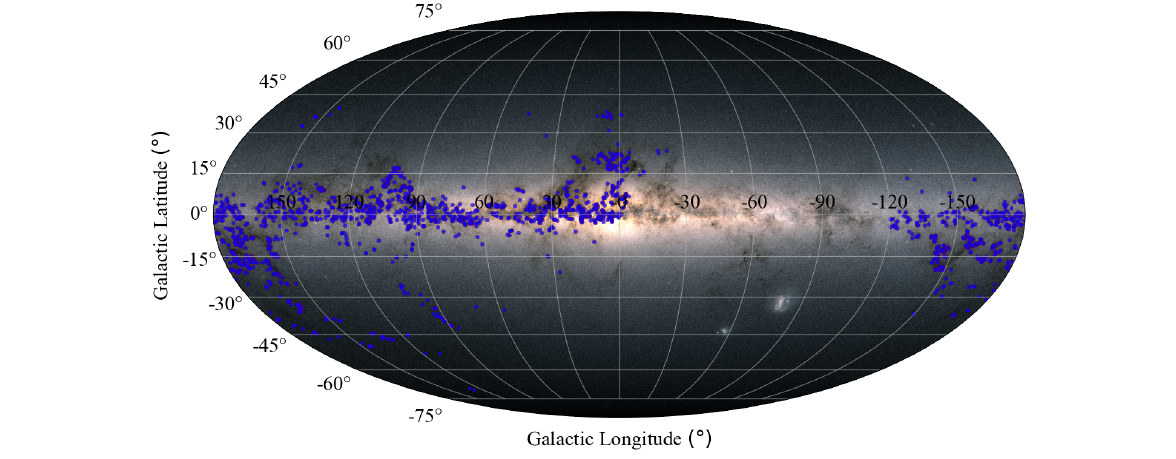
The distribution of 2008 Planck cold clumps in the Milky Way (blue dots), the background displays the Gaia all-sky map combining G, GBP, and GRP bands.
Attachment Download:





