
Stars Can Change Their “Rhythm”: Researchers Reveal Complex Pulsation Changes in a δ Scuti Star
Stars in the night sky may appear calm and unchanging, but some stars are actually in constant “vibration.” Just as a musical instrument can produce multiple notes at the same time, stars can also exhibit multiple pulsation modes. By observing tiny changes in stellar brightness, astronomers can study these “stellar vibrations” and gain insights into the physical processes occurring inside stars.
Using long-term observations from the Kepler and TESS space telescopes, YAO Jianwei , a PhD student at the Optical Astronomy and Technology Research Division of the Xinjiang Astronomical Observatory, Chinese Academy of Sciences, under the supervision of Prof. Ali Esamdin, carried out a study on the δ Scuti pulsating variable star KIC 4737720.
The research results have been published in The Astrophysical Journal (2026, ApJ, 1010, 188).
The researchers found that the star’s main pulsation frequencies remain relatively stable, while the amplitudes of different pulsation modes change significantly over time, with the dominant pulsation mode even changing from one mode to another. This suggests that complex interactions may occur among different pulsation modes inside the star.
δ Scuti stars are a class of rapidly pulsating stars, with brightness variations typically occurring on timescales of only a few hours. Different pulsation modes can be regarded as different “ways of vibrating” inside a star, and their changes provide important clues for studying stellar interiors and physical processes.
Long-term observations of KIC 4737720 show that during the Kepler observation period, one pulsation mode that was initially dominant gradually weakened, while another mode became stronger and eventually surpassed it. During the subsequent TESS observations, the dominant pulsation component changed again, as shown in Figure 1.
Further analysis revealed that these changes mainly occurred in the pulsation amplitudes rather than in large shifts of the main frequencies. In other words, the star did not simply change its “pitch”; instead, the relative strengths of different “notes” changed over time. This behavior may be related to nonlinear interactions between pulsation modes, energy redistribution, and stellar rotation.
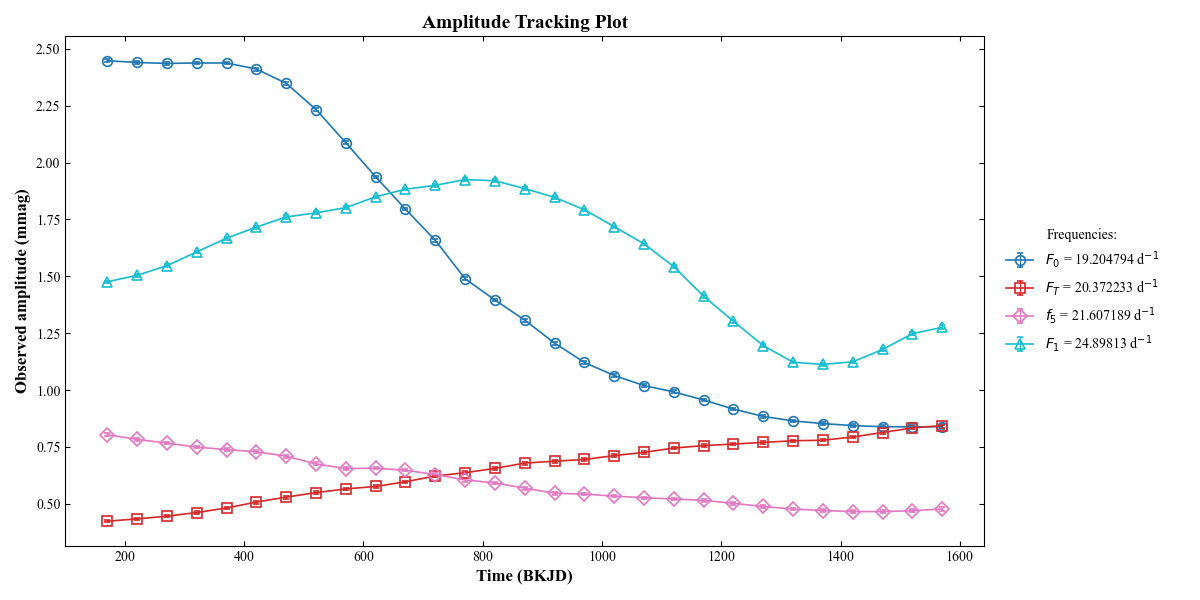
Figure 1. Evolution of the pulsation amplitudes of KIC 4737720.
The study also identified a group of apparently real “V-shaped frequency drifts.” By further examining the Kepler target-pixel data and pointing-correction information, the researchers found that these structures recur on a timescale of about 372 days, which is very close to Kepler’s annual roll period of approximately 372.5 days, as shown in Figure 2. These variations are therefore more likely to have been caused by instrumental effects associated with the operation and observation process of the telescope, rather than by periodic changes in the star itself.
This result also highlights the importance of carefully distinguishing intrinsic stellar signals from instrumental effects when studying subtle stellar variability with space telescopes, in order to avoid interpreting signals produced by the observing system as genuine physical changes in the star.
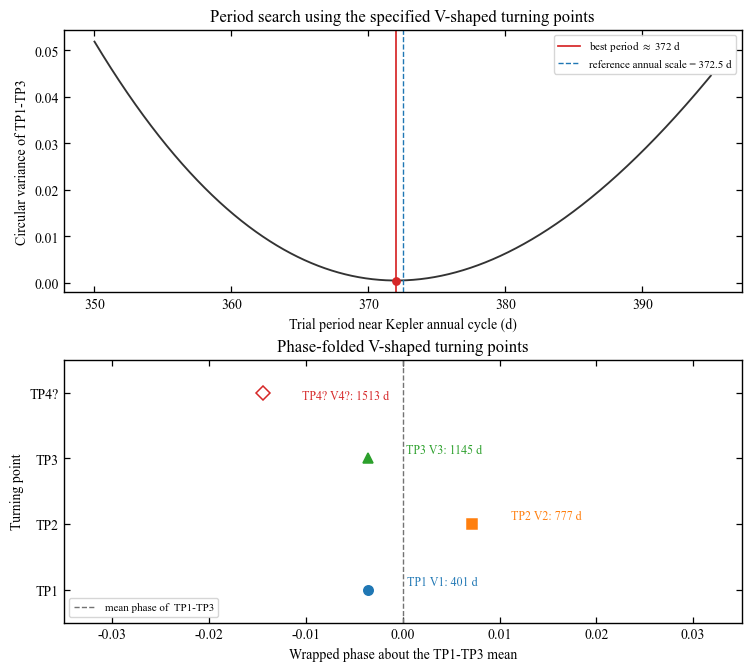
Figure 2. Period analysis of the V-shaped frequency-drift features in KIC 4737720.
Infuture research, combining longer time-series photometric observations, spectroscopic observations, and pulsation models that take rapid stellar rotation into account may help further reveal the physical mechanisms underlying these changes in the “rhythm” of stars.
Paper link: https://iopscience.iop.org/article/10.3847/1538-4357/aea20a
Attachment Download:




