
Stellar Pulsations Reveal a Massive Unseen Companion
Some massive stellar companions are difficult to detect because they emit little visible light or show no obvious signs of accretion. However, their gravitational influence can be traced through the motion of nearby stars. For pulsating stars, regular brightness variations can serve as natural clocks, offering a way to detect these hidden objects.
Using high-precision observations from TESS satellite, Dr. LV Chenglong, a special research assistant from the Optical Astronomy and Technology Application Research Division at the Xinjiang Astronomical Observatory, Chinese Academy of Sciences, and his colleagues investigated the δ Scuti star TIC 160582982. They found a massive unseen companion with a minimum mass of 1.8 solar masses, suggesting that the system may contain a neutron star or a stellar-mass black hole. The results were published in The Astrophysical Journal (2026, ApJ, 1010, 199).
Located about 860 light-years from Earth, TIC 160582982 exhibits stable pulsations that can be used to measure its orbital motion. By analysing six high-frequency pulsation modes, the researchers determined an orbital period of 89.29 days and an eccentricity of approximately 0.54. An independent frequency-modulation analysis confirmed the orbital solution, providing reliable dynamical constraints on the companion's mass.
If the companion were an ordinary main-sequence star, it would be expected to contribute approximately 20%-25% of the system's optical and near-infrared light. However, the available photometric and spectroscopic observations show no clear evidence of this additional contribution, making a single ordinary main-sequence companion unlikely.
These findings demonstrate the potential of stellar pulsation timing to identify massive unseen companions and search for compact objects without obvious accretion signatures. The study also provides new constraints for understanding binary-star evolution. Future high-resolution spectroscopy and Gaia astrometric observations may help determine the true nature of the companion.
Article link: https://doi.org/10.3847/1538-4357/aea560
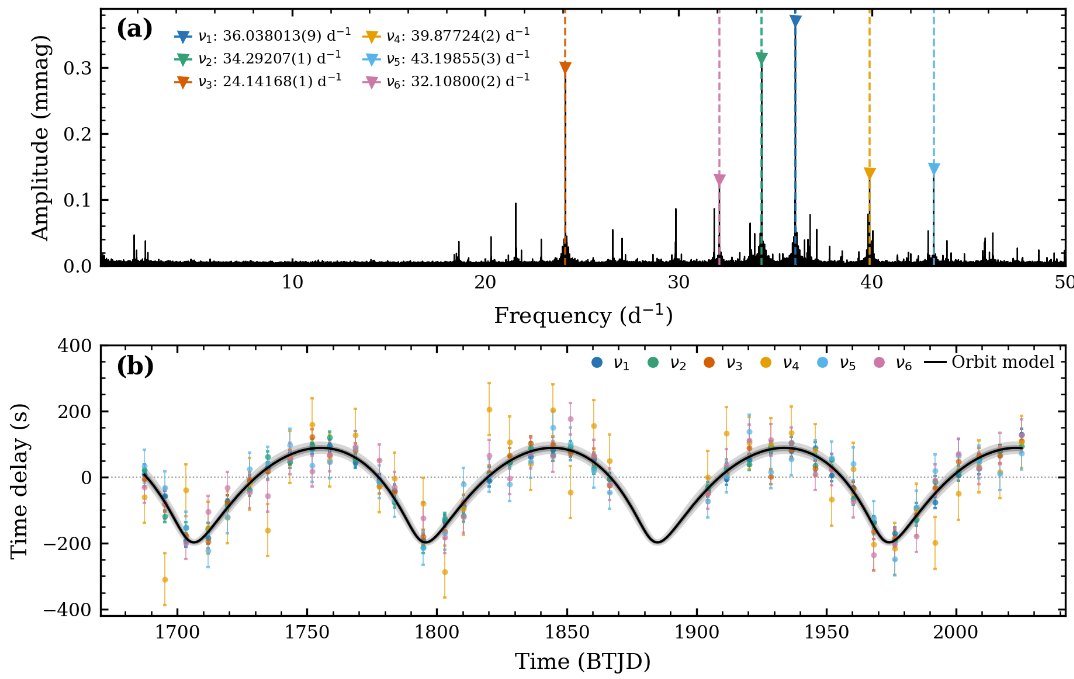
Pulsation spectrum and orbital timing measurements of TIC 160582982, revealing an orbital period of 89.29 days.
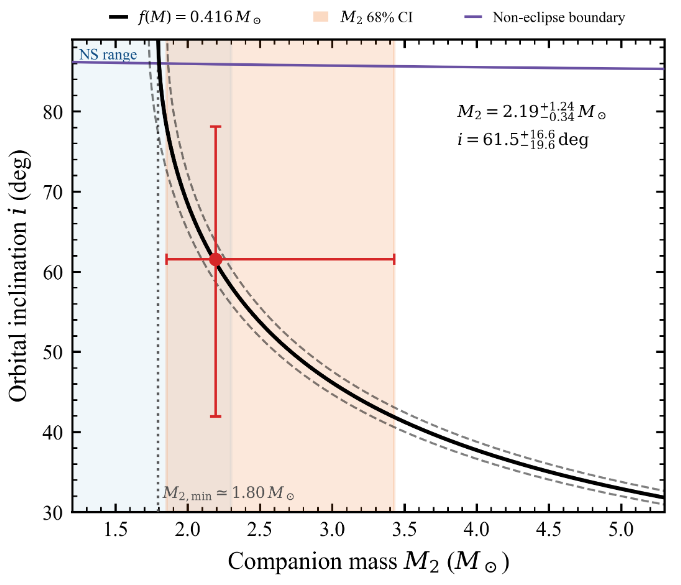
Companion mass constraints for TIC 160582982.
Attachment Download:




