
Researchers Reveal Complex Gas Dynamics and Chemistry in IRDCs
Massive stars form within cold, dense molecular clouds, where their formation is governed not only by gravitational collapse and gas accretion but also by the interplay of temperature, turbulence, shocks, and chemical processes. Investigating the physical conditions, gas dynamics, and chemical evolution of these environments is therefore essential for understanding how massive stars form and evolve.
Infrared dark clouds are cold, dense molecular clouds that appear dark against the bright mid-infrared background of the Milky Way because of dust extinction. They contain dense clumps at early evolutionary stages, some of which have experienced relatively little stellar feedback. These properties make IRDCs valuable laboratories for investigating the initial conditions of massive star and star cluster formation.
Recently, Dr. XIE Jinjin, a postdoctoral researcher in the Star Formation and Evolution Group at the Xinjiang Astronomical Observatory of the Chinese Academy of Sciences, and collaborators conducted multi-molecular-line observations towards 56 dense clumps in infrared dark clouds (IRDCs), using the JCMT 15-m submillimetre telescope in East Asia, the Effelsberg 100-m radio telescope in Germany and the Yebes 40-m radio telescope in Spain. The study highlights the complex physical and chemical environments in which massive stars form. The results have been published in Astronomy & Astrophysics (714, A253,2026).
The research was conducted as part of the molecular-line follow-up observations of ALOHA IRDCs (A Lei Of the Habitat and Assembly of Infrared Dark Clouds), an international Large Programme using the James Clerk Maxwell Telescope (JCMT). The programme employs the SCUBA-2 camera to obtain high-sensitivity dust continuum maps of IRDCs, aiming to investigate their internal structures and the initial conditions of massive star formation. The research team selected 56 dense clumps from the ALOHA programme targets and carried out complementary molecular-line observations in the K band (18–26 GHz) with the Effelsberg telescope and the W band (72.8–91.3 GHz) with the Yebes telescope. By employing different molecular tracers, the team systematically investigated the gas temperatures, kinematics, and chemical properties of these clumps.
The results show that the dense clumps have gas kinetic temperatures of approximately 15–29 K, indicating predominantly cold environments. Nevertheless, 29 of the 56 clumps exhibit molecular-line signatures consistent with possible inward gas motions, suggesting that gas may already be accumulating within these regions. Water maser emission, associated with young stellar activity, was detected towards 22 clumps, while SiO and HNCO emission, which can trace shock-affected gas, was detected towards 19 and 20 clumps, respectively.
In addition, deuterated ammonia (NH₂D), a molecular tracer associated with cold, dense gas chemistry, was detected towards 18 clumps, 12 of which also exhibit water maser emission. These findings suggest that relatively cold, chemically young gas can coexist with active gas motions and early protostellar feedback, demonstrating the complexity of the physical and chemical processes occurring during the early stages of massive star formation.
This study provides new observational constraints on the relationships between gas dynamics, mass accumulation, shock activity, and chemical evolution in the early stages of massive star formation. Furthermore, the observing bands used by the Effelsberg and Yebes telescopes fall within the planned frequency coverage of the QiTai 110-m radio Telescope (QTT), currently under construction in Xinjiang, China. The target sample, multi-band molecular-line observations, and analysis methods established in this study will provide valuable references for future QTT early-science investigations of massive star formation, interstellar molecules, and gas dynamics.
This research was supported by the National Natural Science Foundation of China, the National Key Research and Development Program of China, the Natural Science Foundation of Xinjiang Uygur Autonomous Region, among other funding programmes.
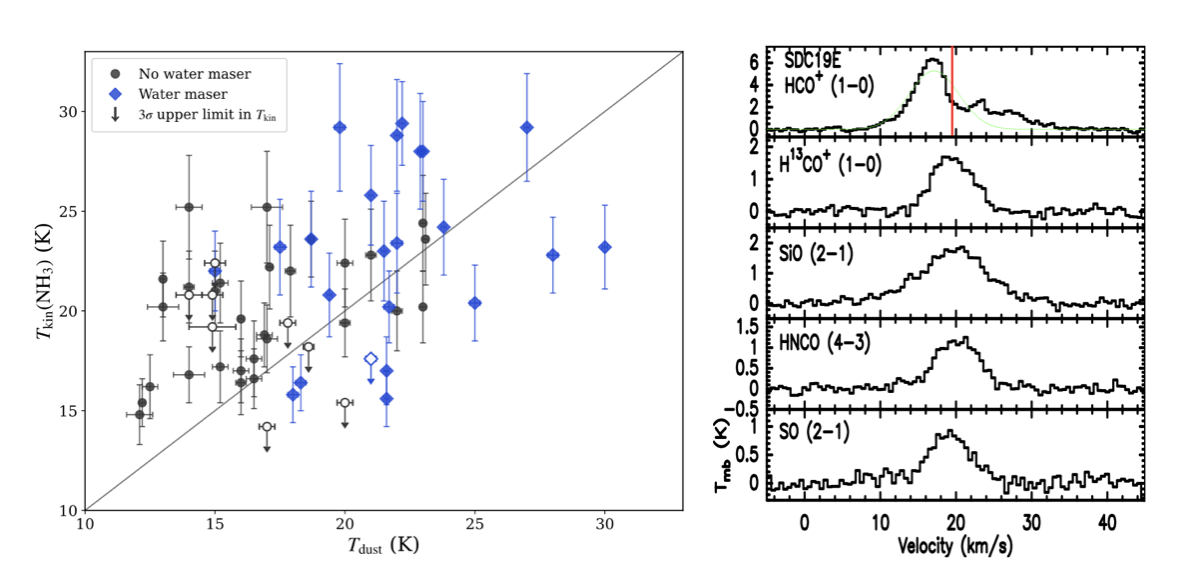
Figure 1. Gas temperatures and molecular-line characteristics of dense clumps in the ALOHA IRDCs sample.Left: Comparison of gas kinetic temperatures derived from NH₃ observations and dust temperatures. Blue diamonds represent sources with detected water maser emission, while grey circles indicate sources without water maser detections. The solid line indicates equal gas and dust temperatures. Right: Molecular-line spectra towards the infrared dark cloud clump SDC19E, including HCO⁺, H¹³CO⁺, SiO, HNCO, and SO. The HCO⁺ line profile exhibits a blue asymmetry, suggesting possible gas infall, while SiO and HNCO emission show features potentially associated with shock activity.
Attachment Download:




