
Time-Variable Periodic Nulling Revealed in PSR B0751+32
Radio emission of some pulsars occasionally ceases suddenly during certain rotation periods, a phenomenon known as "pulsar nulling." When this silence follows a regular, repeating pattern, it is called periodic nulling. Earlier models suggested that periodic nulling might simply be a geometric effect, with our line of sight passing through gaps between sub-beams. Yet whether this interpretation is universally valid has remained a matter of debate.
Prof. YAN Wenming from the Xinjiang Astronomical Observatory, Chinese Academy of Sciences, used FAST to conduct high-sensitivity observations of pulsar B0751+32, capturing the time-variable nature of its periodic nulling. The study reveals that the nulling period varies significantly between different observing epochs and even evolves within a single session.
This discovery challenges the traditional explanation that attributes periodic nulling to fixed geometric effects, suggesting instead that the pulsar's magnetospheric physics is far more dynamic and complex than previously thought. The work has been published in the journal Monthly Notices of the Royal Astronomical Society (2026, MNRAS, 548, stag653).
Using a mixture-model method, the researchers obtained a precise nulling fraction of 35.1 ± 0.6 percent. Pulse-energy analysis shows that both emission components remain stable at the onset of a burst state but progressively weaken toward its end, with the trailing component fading most severely. This indicates that nulling is not a simple on-off switch but rather a gradual decay process, likely caused by the progressive depletion of magnetospheric particles or the slow breakdown of coherent emission conditions.
Previous studies had reported subpulse drifting in B0751+32, but the FAST observations detected no drifting whatsoever. The previously reported "drifting" signatures were likely misinterpretations of periodic nulling due to insufficient sensitivity in earlier data.
This research was supported by the National Key R&D Program of China and the National Natural Science Foundation of China.
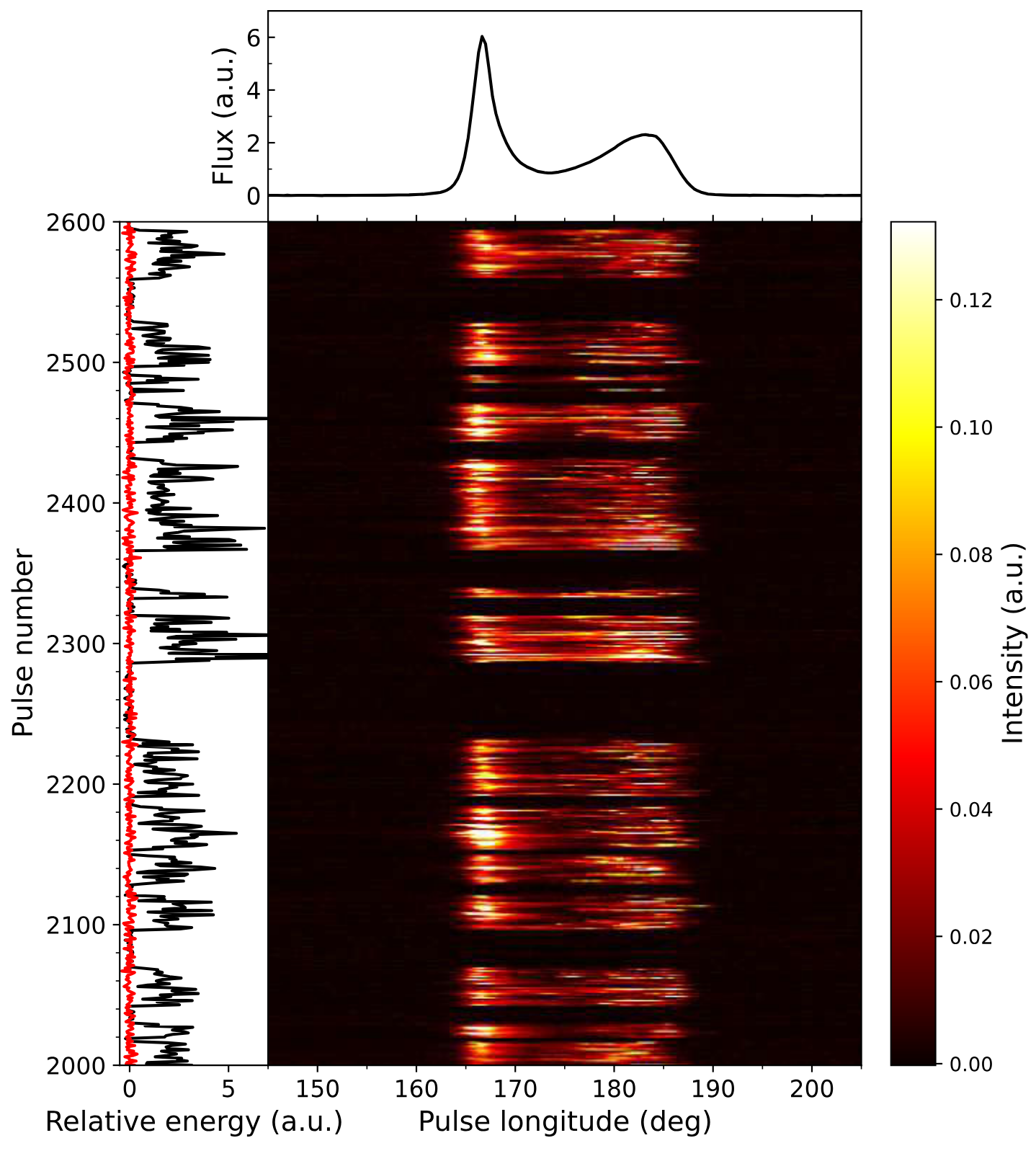
A single-pulse stack of 600 successive pulses of PSR B0751+32.
Attachment Download:





