
Mildly Recycled Pulsars Trace Two Evolutionary Pathways in Intermediate-Mass Binaries
Using the Five-hundred-meter Aperture Spherical radio Telescope (FAST), the researchers from Xinjiang Astronomical Observatory, Chinese Academy of Sciences, conducted long-term follow-up timing observations of two newly discovered binary pulsars, PSRs J1929+4105 and J2359+4239, and obtained phase-connected timing solutions for the first time. The study reveals that both pulsars are in binary systems with massive white dwarf companions, providing new observational data to better understand the evolution of intermediate-mass binary systems into pulsar–white dwarf binaries. The results were published in The Astrophysical Journal.
Both pulsars were discovered by the Commensal Radio Astronomy FAST Survey (CRAFTS) and have spin periods of 41.6 ms and 60.5 ms, respectively. Their orbital eccentricities are both very small. Based on the minimum companion masses inferred from the mass functions—0.72 and 0.467 solar masses, respectively—the researchers suggest that their companions are more likely to be massive white dwarfs rather than neutron stars. Such systems represent an intermediate stage in the pulsar “recycling” process.
Unlike fully recycled millisecond pulsars formed through substantial accretion, these two pulsars experienced only limited transfer of mass and angular momentum, resulting in spin periods of tens of milliseconds. Therefore, they are classified as mildly recycled pulsars.
Using the COMPAS binary evolution code, they found that although the two systems have similar final configurations, they likely followed different evolutionary pathways: PSR J1929+4105 may have undergone a relatively late common-envelope phase, whereas PSR J2359+4239 may have entered a common-envelope phase earlier and subsequently experienced a short-lived mass-transfer episode.
The study also incorporated newly discovered FAST binary pulsars to update the Galactic height distribution of various system types. The results indicate that systems with more massive companions tend to be located closer to the Galactic plane, whereas systems with lighter companions are more widely distributed. These findings offer new insights into how supernova kicks, binary mass, and evolutionary timescales collectively influence pulsar population distributions.
With longer timing baselines in the future, the researchers aims to detect post-Keplerian parameters in these systems, such as shapiro delay and periastron advance, to better constrain the true masses of the neutron stars and white dwarfs. This will help clarify binary evolutionary pathways and provide additional key samples for studies of compact-object mass distributions, Galactic electron-density models, and pulsar population statistics.
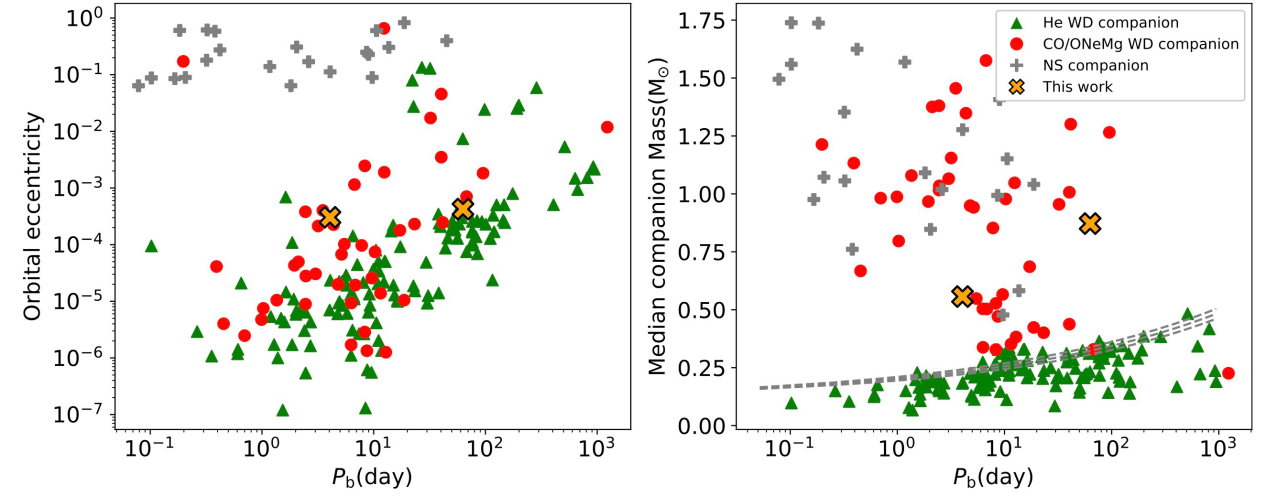
Left panel: the relationship between orbital period and orbital eccentricity for known binary systems. Right panel: the relationship between orbital period and median companion mass for known binary systems.
Attachment Download:





