
A Simulation Study of Solar Flare Termination Shocks as the Origin of GLE Events
WANG Xin, associate researcher at the Xinjiang Astronomical Observatory, CAS, and his collaborators conducted a simulation study on the correlation between solar flare termination shock and Ground-Level Enhancement (GLE) events, revealing that termination shocks can serve as the origin of GLE events. The findings were published in the Journal of Geophysical Research: Space Physics (131(5),2026).
Solar flares and Coronal Mass Ejections (CMEs) are the primary sources of space weather phenomena, both of which may serve as potential triggers for GLE events through high-speed flow-driven strong shocks . The conventional view holds that GLE events are predominantly driven by CME-induced shocks, based on the fact that corresponding solar eruptions are generally accompanied by high-speed CME activity.
However, the lower coronal region of solar flares harbors a powerful proton accelerator—the Termination Shock (TS)—which can even produce high-energy solar cosmic ray protons with energies exceeding 500 MeV, directly triggering GLE processes extending to the Earth's surface.
This study focuses on the relationship between GLE events and TSs, employing dynamic Monte Carlo (DMC) particle simulation methods to model flare TSs. Within this theoretical framework, high-speed thermal particle flows generated by magnetic reconnection converge at the magnetic loop-top to form TS shocks ; through multiple interactions with these shocks, the thermal particles ultimately yield a high-energy particle spectrum exhibiting a power-law distribution.
The simulation results revealed two key phenomena: (1) The particle density in the shock precursor region exhibits a regular "textured" structure, whereas the downstream region displays a stable "woven" configuration; (2) The particle energy spectrum deviates from the standard power-law distribution and shows a distinct "bump-on-tail" between 2 MeV and 20 MeV, indicating that TS possesses exceptional acceleration capabilities.
Based on these findings, TSs are potential sources of GLE, capable of both directly triggering GLE and indirectly providing seed particles for CME-driven shocks.Uncovering the fundamental origins of the GLE event will provide crucial physical insights for accurately predicting space weather, significantly enhancing both the timeliness and precision of forecasts for solar high-energy particle events.
This study was supported by projects including the Natural Science Foundation of Xinjiang Uygur Autonomous Region and the National Key Research and Development Program .
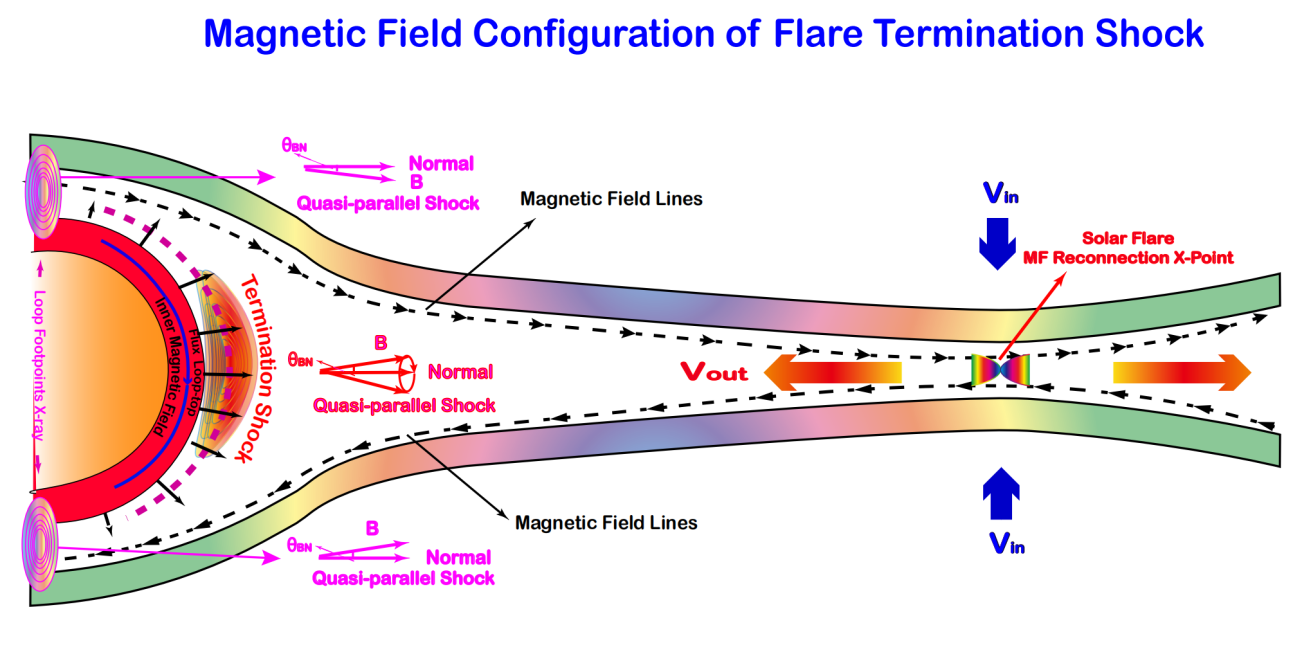


Figure 1: The upper panel illustrates the structure of the termination shock and its magnetic field configuration, while the lower panel demonstrates the density evolution in both upstream and downstream regions using DMC simulation. Simulation results of the flare termination shock model reveal that particle density in the precursor region exhibits a regular "textured" pattern, whereas the downstream region displays a stable "woven" configuration.
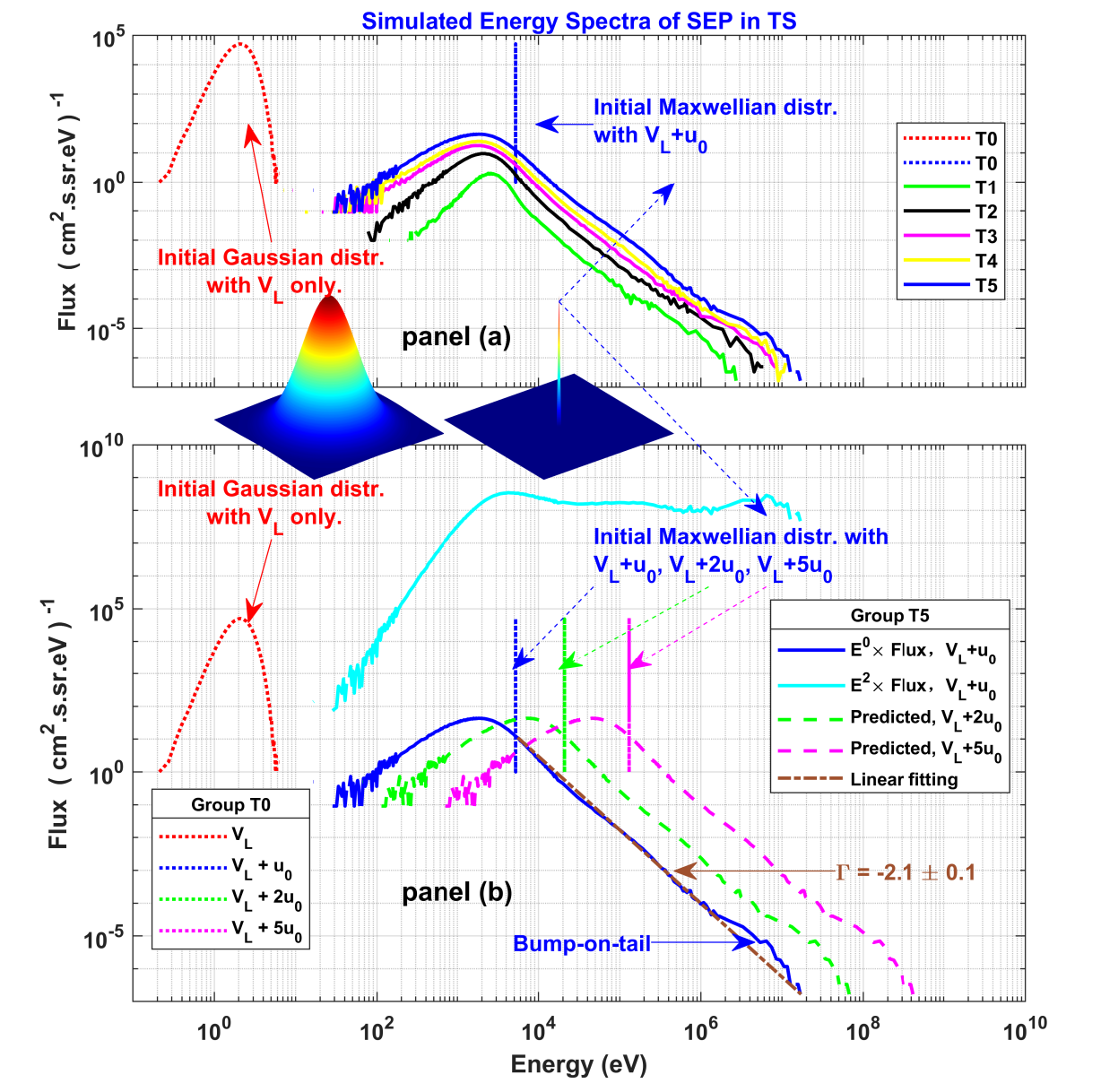
Figure 2: The simulation results demonstrate the termination shock acceleration model for solar flares. By injecting a low-energy particle spectrum from a Maxwell high-speed flow, the acceleration of the termination shock generates an exponential non-thermal power-law energy spectrum with γ = −2.1 ± 0.1 and exhibits a "bump-on-tail " structure in the high-energy region, confirming a direct correlation between the termination shock and GLE events. The upper figure illustrates the evolution of the termination shock's effect on the initial injected spectrum across different time intervals; the lower figure shows that under varying high-speed flow injection conditions, the SEP particle energy spectrum develops a distribution characterized by distinct peaks.
Attachment Download:





