
How Massive Stars Get Their Mass: SDC335 Reveals an Inverted Infall Velocity Profile
Massive stars shape the interstellar medium through intense radiation, stellar winds, and eventual supernova explosions. They play an important role in galaxy evolution and also influence the formation and evolution of nearby low-mass stars. Massive stars form rapidly, so how they acquire enough material within a short time remains a key question in star formation.
A recent study by Dr. XIE Jinjin from the star formation and evolution group of Xinjiang Astronomical Observatory (XAO), Chinese Academy of Sciences (CAS) with the collaboration of the University of Manchester, Tsinghua University, Cardiff University, and other institutions, shows that the gas motions in SDC335.579-0.292 cannot be fully described by the conventional assumption that collapse simply becomes faster toward the centre. Instead, the cloud exhibits an inverted infall velocity profile.
SDC335.579-0.292, hereafter SDC335, is a massive star-forming infrared dark cloud in the Milky Way. It is located about 3.25 kiloparsecs from the Sun, spans about 2.4 parsecs, and has a total mass of about 5,500 solar masses, with young OB stars forming inside. Its central source SDC335-MM1 has been identified as one of the most massive compact protostellar cores known in the Galaxy, making SDC335 an important target for studying how massive stars obtain material from clouds.
In observations of infall, optically thick lines such as HCO+ display self-absorption features in the blue-shifted peak is stronger than the red-shifted peak, and the systemic velocity traced by the optically thin isotopologue H13CO+ appears in the self-absorption dip, the line profiles provide stronger evidence for inward gas motion. In this work, the team analysed spatially resolved HCO+ and H13CO+ spectral maps from the MALT90 survey obtained with the Mopra 22-m telescope. They then combined the observations with the Hill5 semi-analytical model and radiative transfer models, including LIME, RADMC-3D, and RATRAN, to infer the underlying velocity field. This multi-model comparison improves the reliability of the inferred infall velocities and highlights the limitations of simplified models in complex massive star-forming regions.
The best-fitting models constrain the infall velocity toward the cloud centre to about 0.6–1.6 km s-1, with a mass infall rate of a few 10-3 to 10-2 solar masses per year. Most importantly, the infall velocity does not increase monotonically toward the centre. It reaches a minimum at about 0.7 pc and increases again toward both smaller and larger radii. This inverted velocity structure suggests that massive stars do not grow through a single smooth radial inflow, but through mass transport regulated by cloud structure, fragmentation, filamentary gas flows, and local dynamics.
The study also revisits the interpretation of molecular linewidths. Line broadening is often attributed to turbulence, but in SDC335 the widths of optically thin lines may be strongly affected, or even dominated, by unresolved ordered infall motions within the telescope beam. These findings provide new observational constraints on global collapse and mass delivery in massive-star formation.
The results have been published in Monthly Notices of the Royal Astronomical Society. This work was supported by the National Natural Science Foundation of China, the National Key R&D Program of China, the International Partnership Program of the Chinese Academy of Sciences, Natural Science Foundation of Xinjiang Uygur Autonomous Region, the Regional Collaborative Innovation Project of Xinjiang Uygur AutonomousRegion, Tianshan Talent Training Program, and Tianchi Talent Project of Xinjiang Uygur AutonomousRegion.
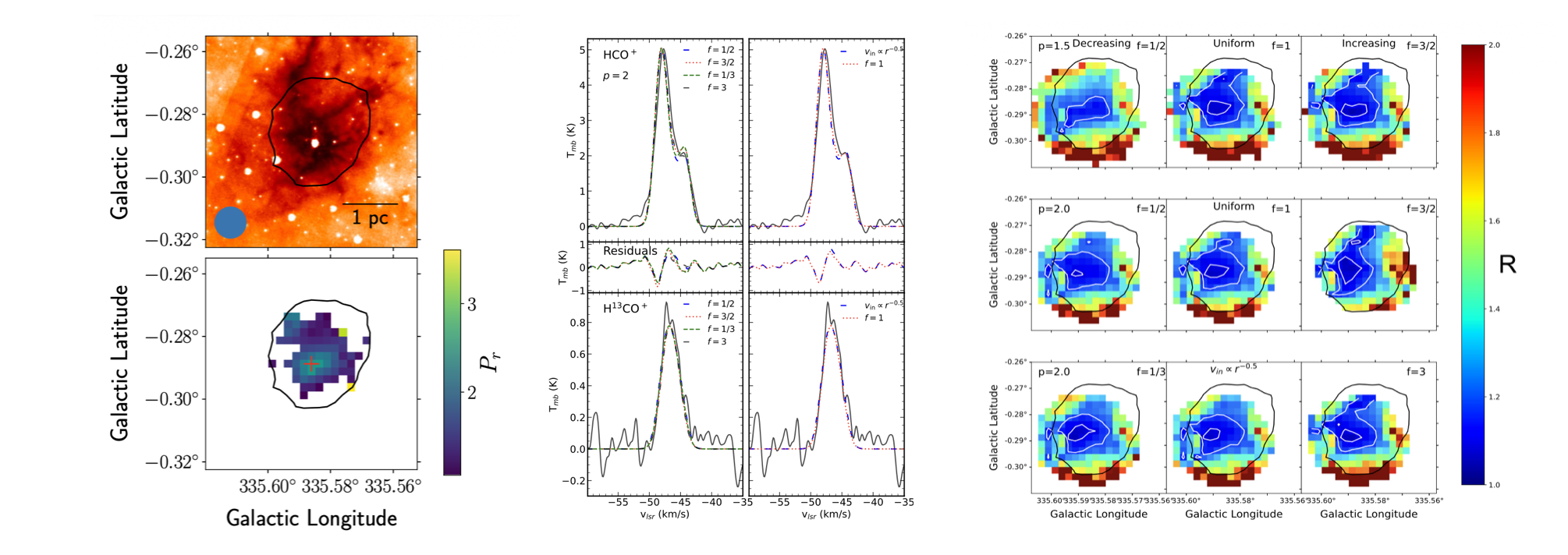
Right: SDC335.579-0.292 image at Infrared and distribution of the ratio of blue-shifted peak to red-shifted peak: Middle: The central pixel of HCO+and H13CO+ from different models compared with observational data; Right: The spatial distribution of discrepancies of models and observational data.
Attachment Download:




