
Boundary-Layer Turbulence and Wind-Field Monitoring at the Muztagh-ata Station
Ground-based optical astronomical observations must pass through Earth’s atmosphere. Image motion of stars caused by atmospheric turbulence can severely affect optical astronomical observations. Under the supervision of his advisor, Aili Yishamuding, PhD candidate GU Wenbo of Xinjiang Astronomical Observatory used coherent Doppler wind lidar to carry out long-term wind-profile observations at the North-1 site of the Muztagh-ata station. By combining these data with simultaneous measurements from a seeing monitor and a 30-meter meteorological tower, he carried out a joint analysis ofthe characteristics of optical turbulence and seeing within the lowest 3 km above the site.
The analysis shows that the median integrated seeing in the 6–1000 m altitude layer is approximately 0.60 arcseconds, and this layer contributes a median of 59% to the total atmospheric seeing. Within this layer, the thin layer from 6 to 200 m above the ground accounts for more than 63% of the turbulence energy in the 6–1000 m range. The study confirms that the atmospheric layer below 200 m is the key physical layer determining the optical observing quality of the Muztagh-ata site.
The study found that atmospheric turbulence at the Muztagh-ata site is jointly influenced by both thermal and dynamic processes. During the daytime, turbulence is dominated by thermal convection caused by surface heating, allowing turbulent motions to develop upward to approximately 1500–2000 m. At the same time, mechanical turbulence induced by strong wind shear is also a key factor affecting seeing. In all seasons, turbulence exhibits pronounced diurnal variation: after sunset, turbulence rapidly weakens and the atmospheric environment becomes more stable.
In addition, the research team compared and validated ERA5 reanalysis data. The results indicate that ERA5 is highly reliable for estimating nighttime optical turbulence, but it shows certain biases during the daytime when surface convection is strong. Therefore, such data should be used with caution in daytime turbulence modeling.
The Muztagh-ata site has relatively excellent seeing conditions and a stable turbulence environment, giving it great potential to become an important optical astronomical observing site in western China. This study was jointly supported by the National Natural Science Foundation of China and the “Light of West China” Talent Program of the Chinese Academy of Sciences.
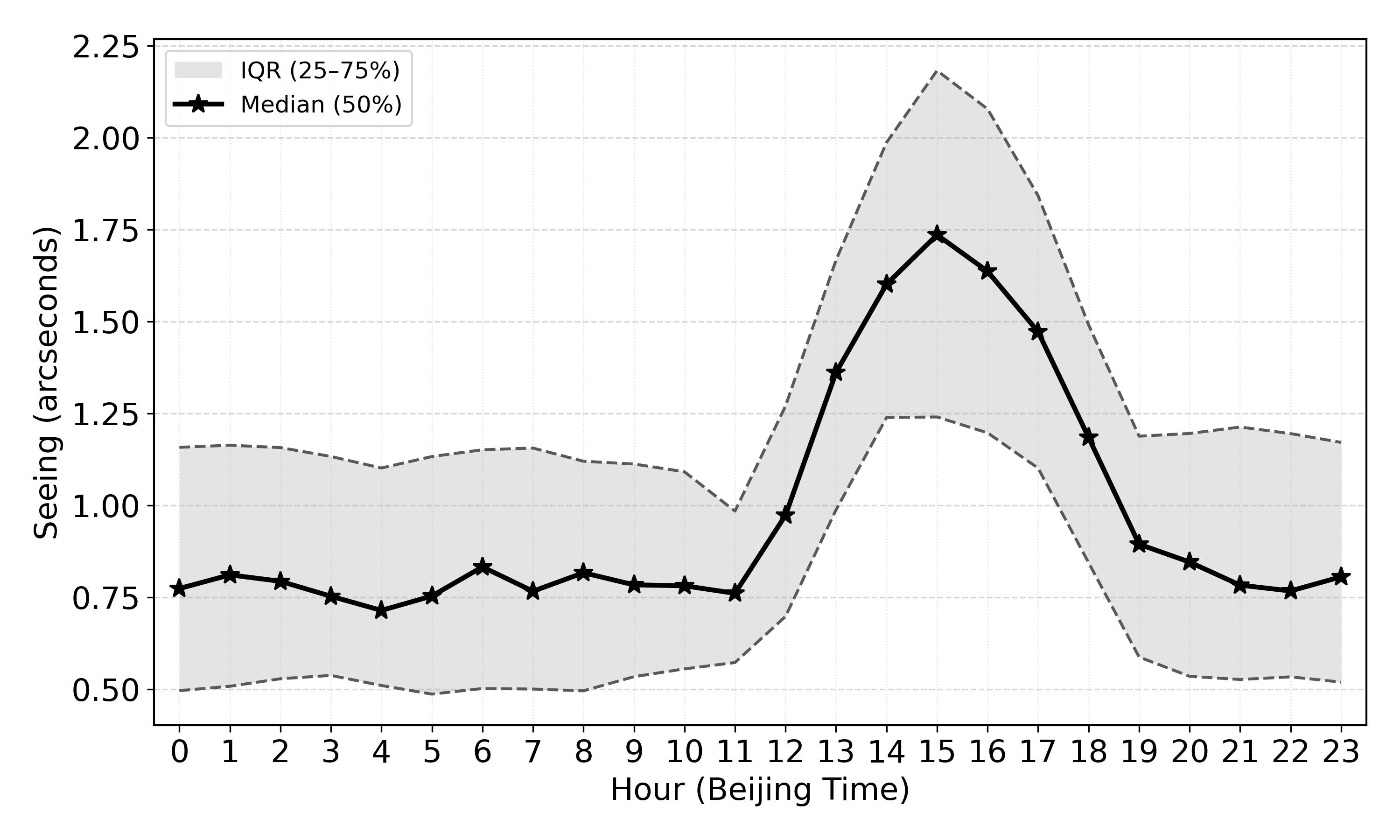
Diurnal variation of the lay er-int egrat ed seeing deriv ed from the combined C2n profiles for the altitude range of 6–1000 m. The solid black line r epr esents the median value, while the grey shaded area indi-cates the interquartile range (IQR, 25–75 per cent).
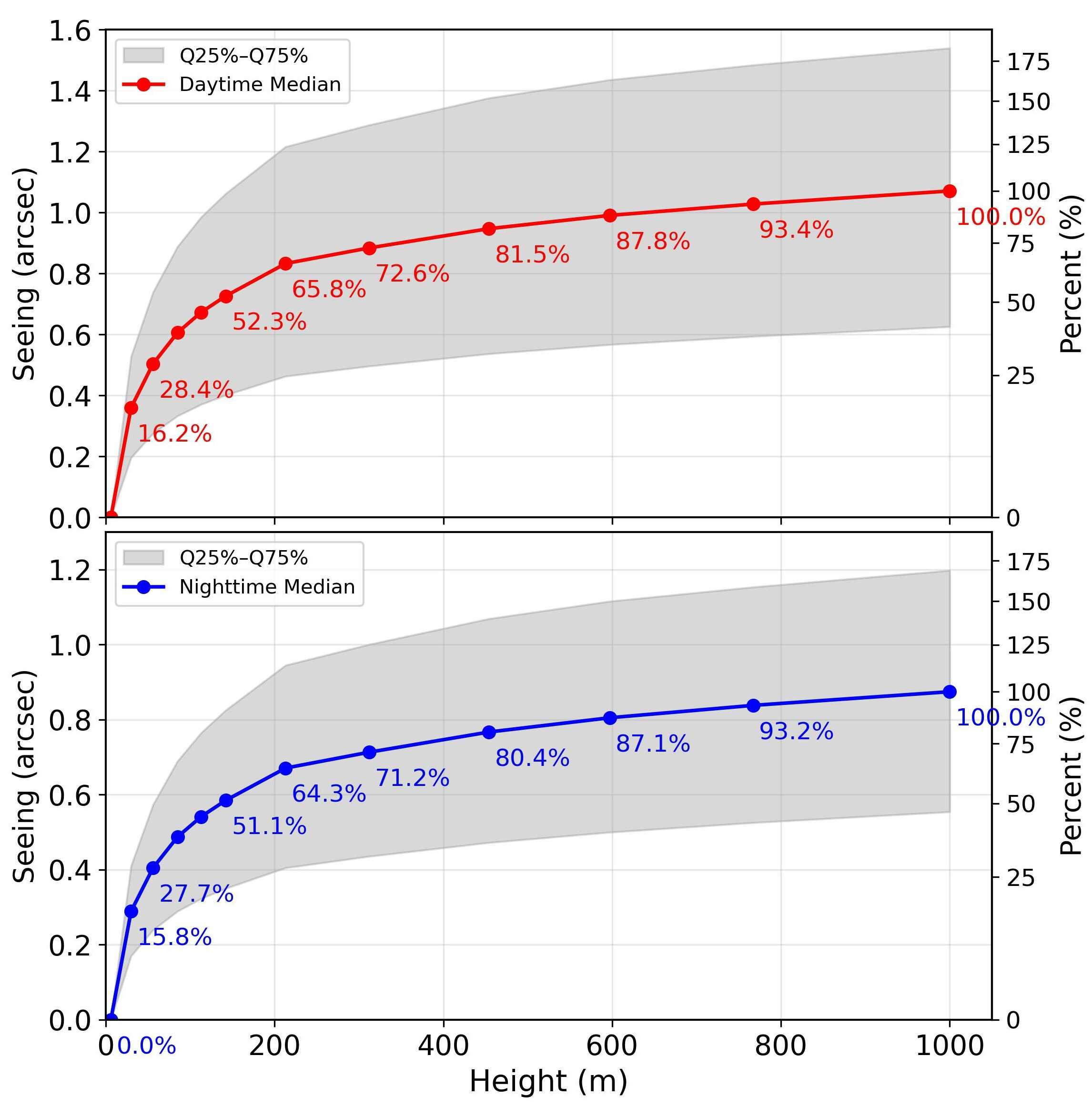
Vertical profiles of cumulative seeing and their relative contribution percentages as a function of altitude within the 6–1000 m layer. The upper panel presents the daytime results, while the lower panel shows the nighttime results.
Attachment Download:




