
Three High-Amplitude δ Scuti Stars Show Unexpected Pulsation Complexity
High-Amplitude δ Scuti stars (HADS) are intermediate-mass pulsating variables traditionally considered to be dominated by radial pulsations, making them important probes of stellar structure and evolution. However, recent high-precision space photometry has revealed that some HADS exhibit more complex pulsation behavior and amplitude variations, challenging this simplified picture.
Using high-precision short-cadence data from TESS, Dr. LV Chenglong from Xinjiang Astronomical Observatory, Chinese Academy of Sciences, discovered and analyzed three new HADS: TIC 408074920, TIC 189714989, and TIC 34137913. Their pulsation properties were investigated using Fourier analysis, sliding-window amplitude variations, SED fitting, and asteroseismic modeling. The results have been published in The Astrophysical Journal (2026, ApJ, 1002, 101).
All three stars show dominant radial pulsations with rich harmonic structures. TIC 189714989 exhibits symmetric side peaks around the main frequency, suggesting possible amplitude and/or phase modulation similar to the Blazhko effect in RR Lyrae stars, and also shows an additional non-radial mode. TIC 408074920 displays a ~4 mmag amplitude decrease over ~20 days, indicating possible short-term amplitude variability.
Combining Gaia DR3-based SED fitting with stellar evolution and pulsation modeling, all three stars are found to lie within the classical instability strip, with masses of 1.5-1.8 M☉. However, discrepancies between SED and asteroseismic estimates of radius and luminosity suggest that higher-precision spectroscopic constraints are still needed.
These results indicate that HADS pulsation behavior is more complex than traditionally assumed, highlighting rich nonlinear processes revealed by space-based photometry. Future missions such as PLATO will further improve our understanding of mode excitation and amplitude modulation in intermediate-mass stars.
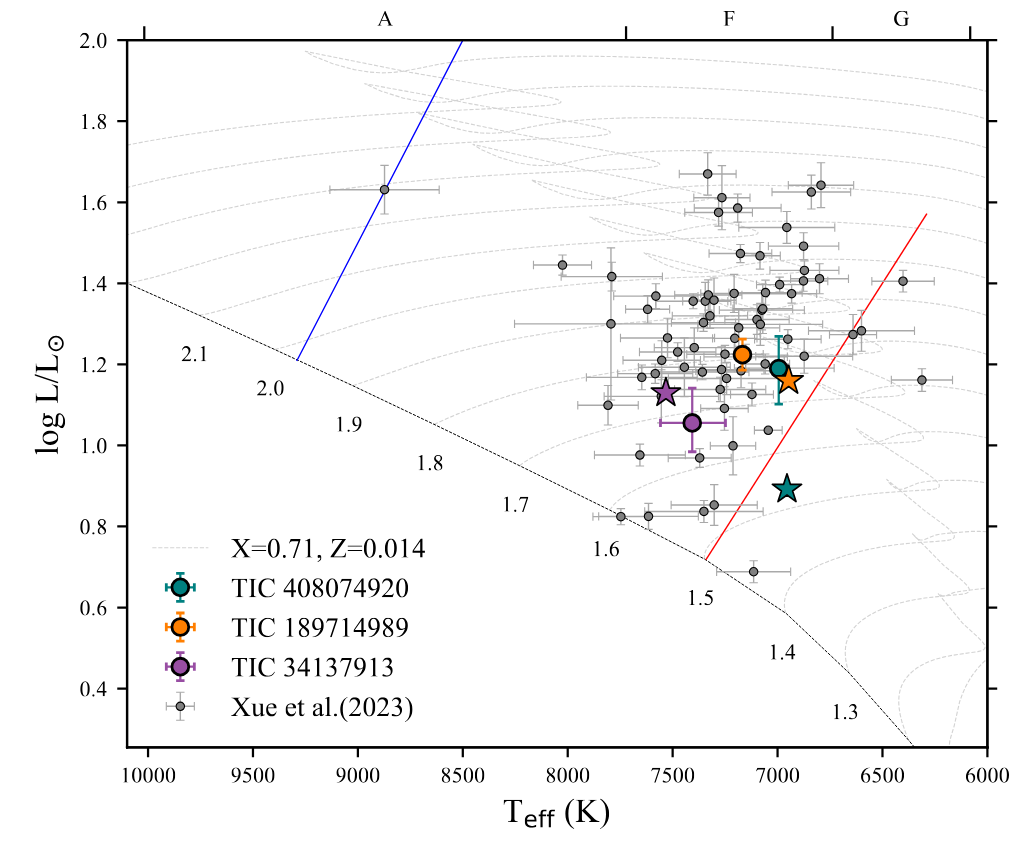
Positions of the three HADS in the HR diagram, where circles and stars denote the results derived from SED fitting and asteroseismic modeling, respectively.
Attachment Download:





