
Observational Evidence of Bidirectional Solar Jets Driven by Magnetic Reconnection
Magnetic reconnection is the core physical process of energy release in the solar atmosphere, triggering and driving various scales of solar eruptive activities, including flares, coronal mass ejections (CMEs), and different types of jets. Solar bidirectional plasma jets manifest as plasma flows driven simultaneously in opposite directions from the reconnection site. They are direct observational evidence of magnetic reconnection between newly emerged magnetic flux or local eruptions and the overlying large-scale horizontal magnetic fields.
However, limited by the spatial resolution of observational instruments, direct observational evidence of the fine-scale triggering mechanisms and magnetic field evolution of bidirectional jets in the lower solar atmosphere (photosphere and chromosphere) is rarely reported.
Recently, under the guidance of Prof. SHEN Jinhua, graduate student LIU Yangyufrom the solar physics research group of the Xinjiang Astronomical Observatory (XAO), Chinese Academy of Sciences (CAS), utilized sub-arcsecond high-resolution observations from the Goode Solar Telescope (GST) and the Solar Dynamics Observatory (SDO) to reveal the process of lower-atmosphere magnetic reconnection driving bidirectional plasma jets and coronal heating. The related research findings have been published in the international astronomical journal The Astrophysical Journal.
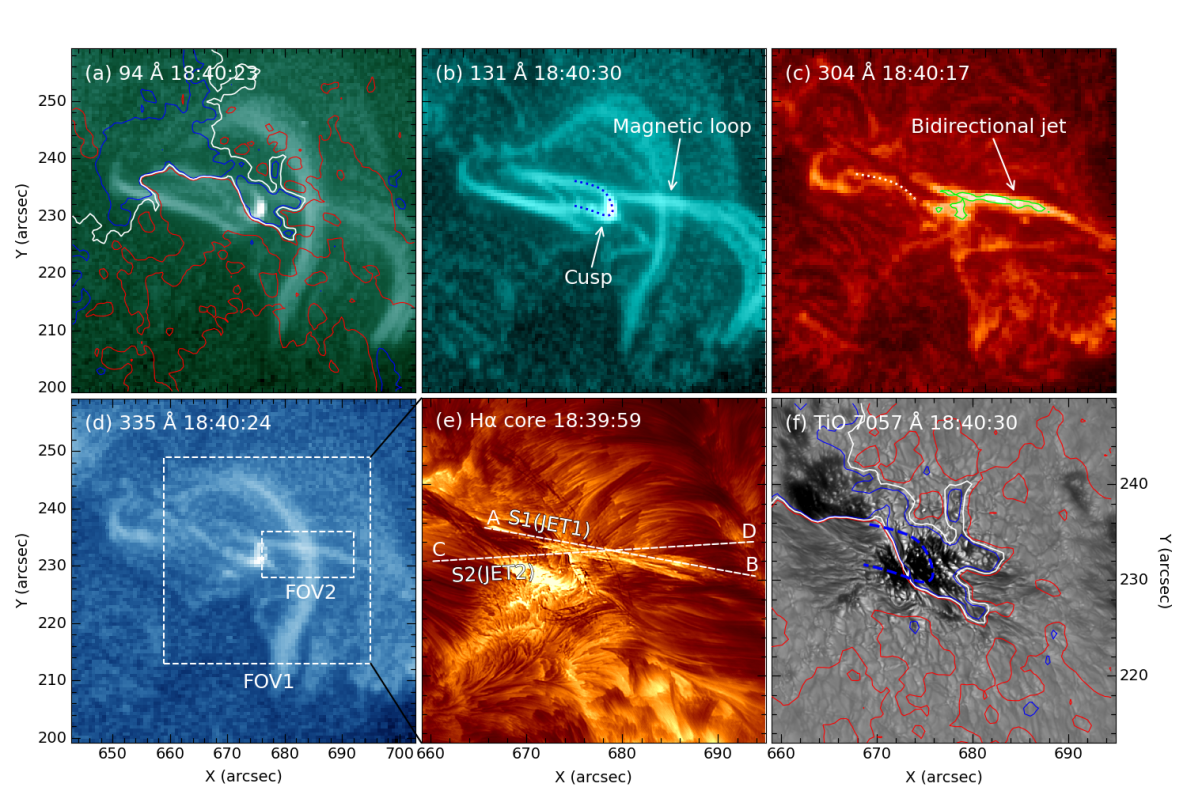
Figure 1: SDO/AIA images in the 94, 131, 304, and 335 Å passbands, showing the erupting bidirectional jet (JET1) in active region 13110 and its accompanying magnetic loop heating, along with Hα chromospheric and TiO photospheric observation images.
The researchers focused on two groups of bidirectional jet events occurring at the edge of the leading sunspot in active region NOAA 13110 on October 2, 2022, recorded as group 1 and group 2.Photospheric magnetogram observations indicate that both bidirectional jets originated near the polarity inversion lines (PILs) at the intersection of the sunspot's umbra and penumbra. The solar jet process was accompanied by continuous magnetic flux emergence and magnetic cancellation, which accumulated free magnetic energy for the eruptions in the upper atmosphere.
Based on the extremely high spatial resolution of GST (about 0.1 arcseconds), the researcherscaptured fine dynamic structures in the chromospheric Hα observations: a large number of horizontal filamentary threads or filament material continuously emerged from the lower chromosphere and slowly rose. When these cold-mass-carrying filamentary threads rose and reconnected with the overlying horizontal magnetic fields, it not only caused intense heating of local plasmas but also drove bidirectional plasma jets with speeds up to tens of km/s.
For the first group of jets, the initial brightening first appeared in the transition region, indicating that the initial reconnection occurred at a higher transition region altitude. For the second group, which possessed a highly twisted magnetic structure, the initial reconnection responded simultaneously in the chromosphere and corona, exhibiting recurrent bidirectional jets.
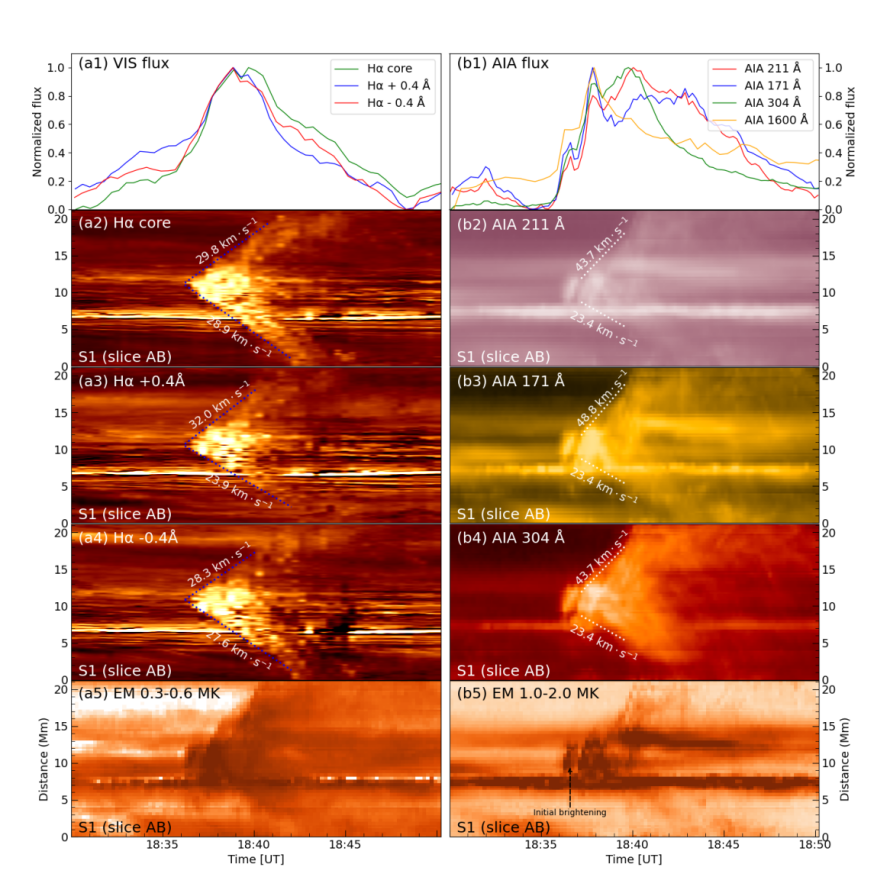
Figure 2: Space-time diagrams along the jet direction (S1) in different passbands, clearly showing the bidirectional jet symmetrically ejected to both sides centered on the reconnection point. The DEM analysis proves that the bidirectional jets have a multi-thermal structure.
The researchers constructed a complete physical picture of bidirectional jets, from small-scale triggering to large-scale eruption, through sub-arcsecond high-resolution observations. The observations also revealed that, accompanying the reconnection of filamentary threads, a large number of nanoflare-like micro bright points appeared in the chromosphere.
Meanwhile, the overlying heated coronal magnetic field lines rapidly restructured from a crossed state into a parallel topology, accompanied by numerous plasmoids moving along the magnetic loops.
These observational results indicate that filament-level micro-magnetic reconnection in the lower atmosphere is not only the direct engine driving macroscopic bidirectional jets but also a physical mechanism leading to localized coronal heating and mass transport to the upper atmosphere.
This work was jointly supported by the National Natural Science Foundation of China (12273101), the Strategic Priority Research Program of the Chinese Academy of Sciences (XDB0560000), the Natural Science Foundation of Xinjiang Uyghur Autonomous Region (2024D01E38), and the Xinjiang Talent Development Fund.
Attachment Download:





