
A Young Pulsar in the Galactic Halo: Clues to Its Origin and Scintillation
A young pulsar located far from the Galactic disk, in the Galactic halo, is challenging the long-held view that pulsars are predominantly born in the disk. By precisely measuring its motion across the sky and analyzing the “scintillation” of its radio signal, researchers find that this object may have originated in the halo, while its observed scintillation is closely linked to its surrounding pulsar wind nebula (PWN) . These results provide new insights into both the origin of young halo pulsars and the physical mechanisms responsible for pulsar scintillation in PWN settings.
The study focuses on the young pulsar PSR J1740+1000 and was carried out by Associate Professor YAO Jumei at the Xinjiang Astronomical Observatory, Chinese Academy of Sciences, together with her collaborators. The results have been published in The Astrophysical Journal.
Using long-term observations from FAST (the Five-hundred-meter Aperture Spherical radio Telescope) and the Nanshan 26-m radio telescope, the team tracked the tiny positional changes of PSR J1740+1000 on the sky (its “proper motion”; see Fig. 1). Combined with its distance, they derived a space velocity of 329 ± 80 km s⁻¹. Based on its inferred space velocity, PSR J1740+1000 is likely to have formed in the Galactic halo and may be the descendant of a runaway OB star, i.e., a massive star ejected from its birth environment by violent astrophysical events and moving at high velocity.
In addition, by combining the observations from FAST and the Parkes telescope in Australia, , the researchers report, for the first time, multiple adjacent scintillation arcs in the pulsar’s secondary spectrum (see Fig. 2). Further analysis indicates that these arcs most likely originate from AU-scale ionized structures within the PWN surrounding the pulsar. A PWN is produced by the interaction of the pulsar wind with the ambient medium. Our results indicate that its small-scale plasma structures can significantly influence radio wave propagation and play a dominant role in the generation of scintillation.
This work not only provides key observational evidence for the origin of young pulsars in the Galactic halo, but also highlights the important role of PWN in shaping scintillation. It opens a new avenue for probing circumstellar and interstellar environments using pulsar signals.
This research was supported by major science and technology projects of the Xinjiang Uygur Autonomous Region and key programs of the regional Natural Science Foundation.
Article link:
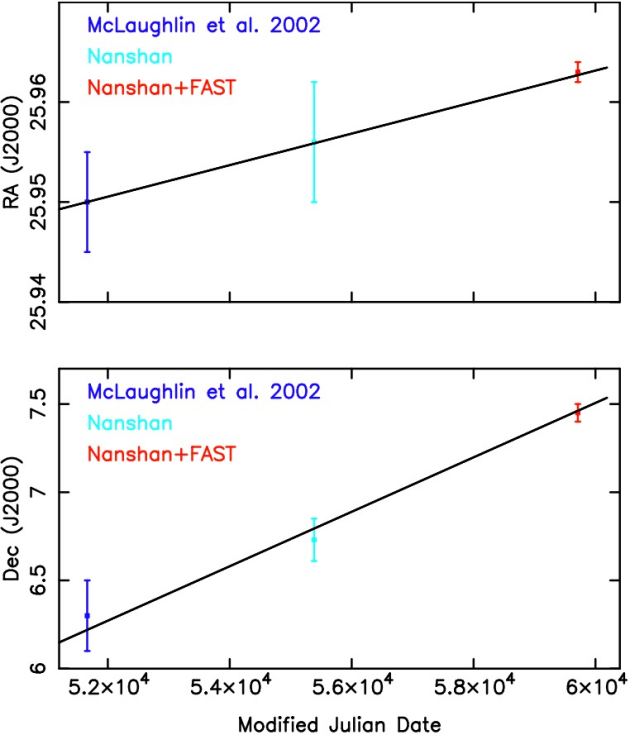
Figure 1: the right ascension and declination positions of the pulsar PSR J1740+1000 at MJDs 51662, 55384, and 59711. The black lines represent the best-fit results of the proper motion in the right ascension and declination directions.
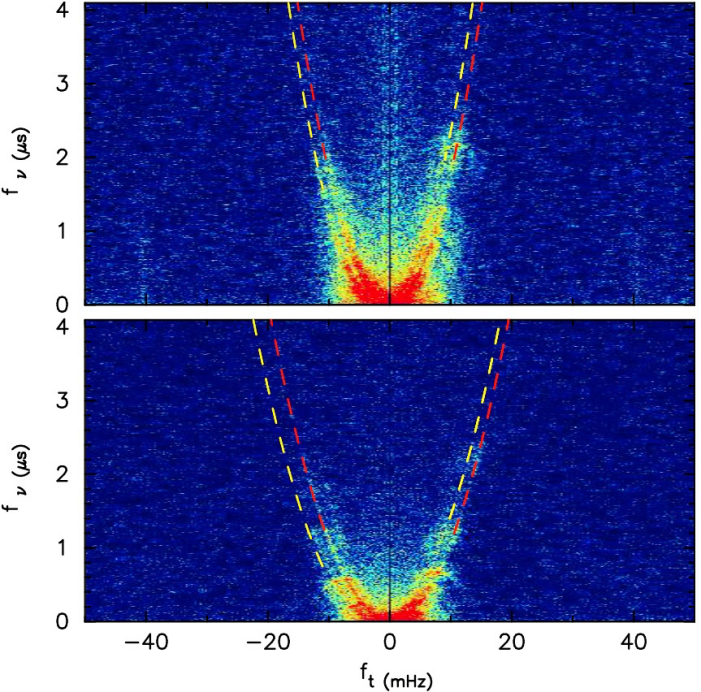
Figure 2: the secondary spectra of the pulsar PSR J1740+1000 at 1100 and 1400 MHz. The red and yellow curves indicate the best-fit curvatures of the two adjacent scintillation arcs.
Attachment Download:




