
Tracking activities of the Universe’s Most Energetic Galaxies with Urumqi NanShan 26 m Radio Telescope
A research team led by Prof. CUI Lang at the Galaxy and Cosmology Group of Xinjiang Astronomical Observatory (XAO), Chinese Academy of Sciences (CAS)—including Krishna Mohana A, WANG Xin, CHANG Ning , TAN Guiping , and LIU Xiang—has unveiled long-term radio data from some of the universe’s most extreme galaxies: gamma-ray-loud active galactic nuclei (AGNs).
These galaxies host supermassive black holes at their centers that drive bright cores and powerful relativistic jets, which extend beyond the galaxy’s size with distances of hundreds to millions of light-years.This study offers a unique insight into the behavior of these cosmic powerhouses, shedding light on how black holes influence their environments across the cosmos.
Launched in late 2016, the SMMAN program (quasi-Simultaneous Multiwavelength Monitoring of Gamma-Ray-Loud AGNs with the Nanshan 26 m radio telescope) tracks 131 northern (δ > ∼ 0∘) AGNs from the Fermi-LAT third source catalog. This first data release by the researchers covers over eight years of observations (2016–2024) at 4.8 GHz and 23.6 GHz. The main goal of the program is to provide multi-frequency radio data obtained at lower frequencies that complements Fermi-LAT gamma-ray observations and other multiband radio/optical-UV/X-ray monitoring programs, enabling a detailed study of the radio/multiband properties of gamma-ray-loud AGNs.
AGNs exhibit strong flux variability across the electromagnetic spectrum, providing key insights into the complex physics of accretion and plasma jets. A special class, blazars, have jets pointed toward Earth, producing Doppler-boosted emission that varies dramatically over minutes to years. These galaxies blaze across the electromagnetic spectrum—from radio waves to gamma rays—making them ideal cosmic laboratories to study the physics of extreme jets and high-energy processes.
The researchers studied the characteristics of variability, spectral index, luminosity, and gamma-ray loudness across the different AGN classes in the sample. Variability is stronger at 23.6 GHz than at 4.8 GHz, with BL Lacertae (BL Lac) objects more variable than flat-spectrum radio quasars (FSRQs). BL Lacs typically show flatter radio spectra, while FSRQs, blazar candidates of uncertain type (BCUs), and radio galaxies (RDGs) span flat to steep spectra. FSRQs are most radio-luminous, BCUs intermediate, and RDGs fainter. Gamma-ray loudness is highest for FSRQs and BL Lacs, intermediate for BCUs, and lowest for RDGs. These findings were recently published in Cui, L., et al. (2026), The Astrophysical Journal Supplement Series (ApJS), 283, 69.
The researchers measures radio signals from active galaxies using a cross-scan method, sweeping the telescope in two orthogonal directions. Observations were made at 4.8 GHz and 23.6 GHz, with multiple passes to capture precise signals. Each pass is analyzed as a Gaussian-shaped signal, and corrections are applied for telescope pointing, atmospheric effects, and instrumental gain. This careful method ensures reliable flux density measurements of SMMAN target sources.
The first data release from this long-term monitoring program in the lower frequency bands provides unique coverage of the radio part of the spectral energy distribution (SED), complementing other historical and ongoing multi-frequency surveys. Together, the SMMAN dataset offers a unique opportunity to track SED evolution, search for quasiperiodic oscillations, and explore supermassive black hole binary systems, shedding new light on the dynamic behavior of these energetic galaxies.
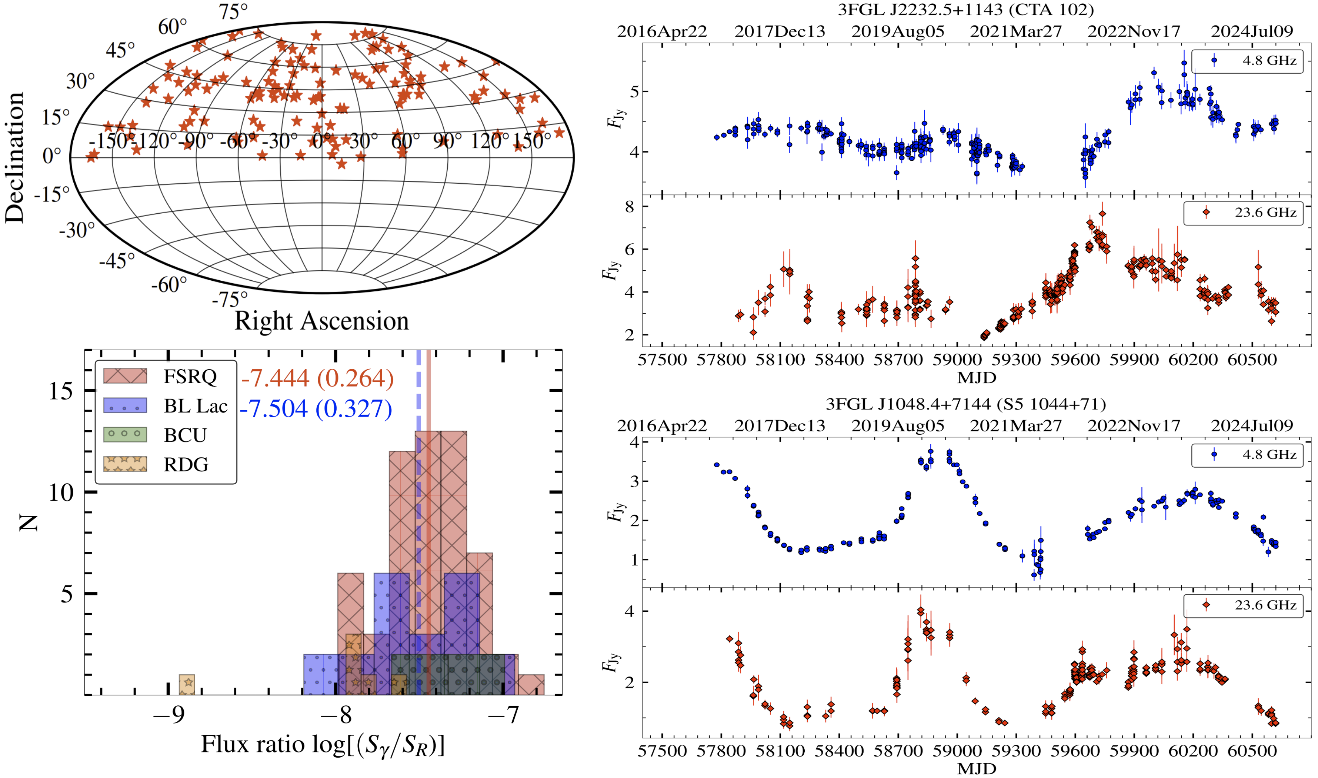
Figure. Top left: the Hammer–Aitoff projection of the SMMAN monitored sources in sky distribution (in equatorial coordinates). Bottom left: distribution of the gamma-ray loudness factor for the SMMAN sample. The transparent solid red and dashed blue vertical lines represent the mean values with standard deviation inside parentheses for FSRQs and BL Lacs, respectively. Right: Example of light curves of the sources monitored by the SMMAN program (Cui et al. 2026, ApJS, 283, 69).
Attachment Download:




