
Research Ucovers Long-Term Pulsation Evolution in the δ Scuti Variable Star KIC 8712760
Stars are not eternally quiet and unchanging celestial bodies; some stars periodically brighten and dim. Astronomers refer to this phenomenon as stellar pulsation. Studying these pulsations is like performing an "ultrasound examination" on a star, helping us understand the physical structure and evolutionary state of its interior.
Recently, a graduate student YAO Jianwei, along with his supervisor Prof. Eli Ismailjanfrom the Optical Astronomy and Technology Application Research Division at the Xinjiang Astronomical Observatory of the Chinese Academy of Sciences, and their collaborators conducted a long-term observational study on the δ Scuti variable star KIC 8712760. Their work revealed a significant evolution of the star's pulsation amplitude over time. The related findings have been published in The Astrophysical Journal(2026, ApJ, 1000, 163).
Using observational data from the ground-based WASP survey project and the space telescopes Kepler and TESS, the researchers performed unified processing and joint analysis of the light curve data obtained from these different platforms and different periods, constructing a nearly two-decade-long observational sequence for the target. The results indicate that the amplitude of the star's dominant pulsation frequency, f1, showed an overall declining trend over the long-term evolution. Meanwhile, another frequency, f2, gradually increased in amplitude during the Kepler observation period and, in some TESS observation windows, surpassed f1 to become the new dominant frequency.
To further trace the evolution of different pulsation modes, the researchers employed methods such as frequency spectrum analysis, sliding-time-window fitting, and amplitude sorting to characterize the variations of the star's several main frequencies. The results show that multiple pulsation modes of this star exhibit a seesaw characteristic, suggesting the observable pulsation energy may be undergoing redistribution among different modes.
Further analysis shows that this long-term amplitude variation is more likely related to nonlinear mode coupling within the star, as well as changes in driving and damping within the ionization zone and the convection layer. This achievement provides new observational evidence for understanding energy transfer, mode competition, and nonlinear pulsation mechanisms in low-amplitude δ Scuti variable stars. It also highlights the important value of multi-platform, long-baseline joint observations in asteroseismology.
This research was supported by the National Key R&D Program of China, the Chinese Academy of Sciences "Tianshan Talent" Program, the Natural Science Foundation of Xinjiang Uygur Autonomous Region, and the National Natural Science Foundation of China.
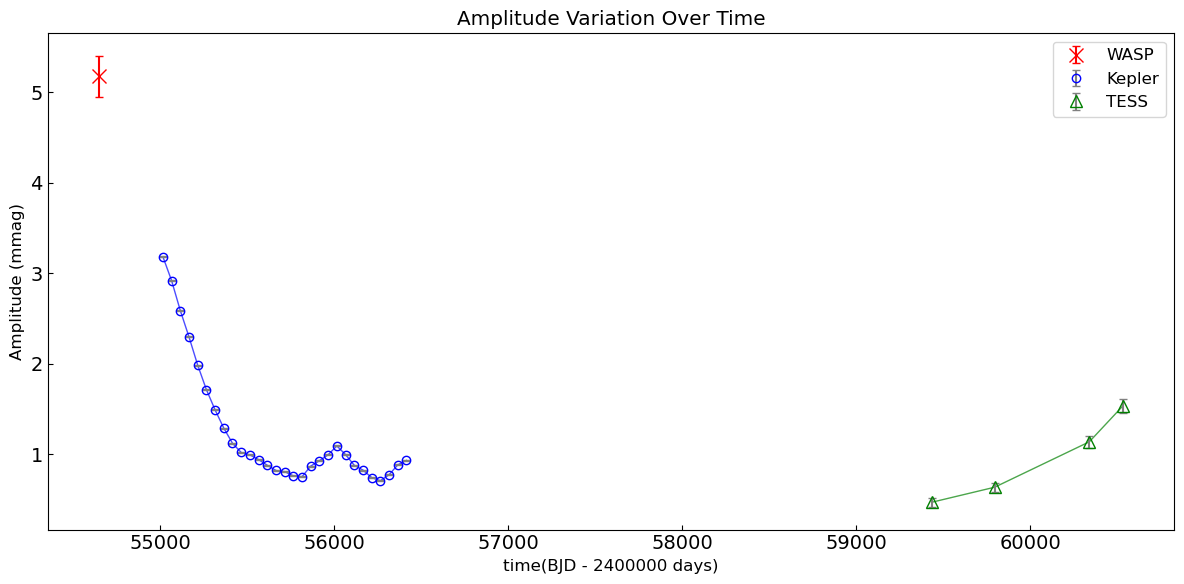
Figure 1: Long-term amplitude evolution of the primary pulsation frequency f1 in KIC 8712760 across WASP, Kepler, and TESS observations. Data points from different observational platforms are represented by distinct colors and symbols. The plot shows that the amplitude of this frequency generally weakened and subsequently exhibited variations over the long-term evolution.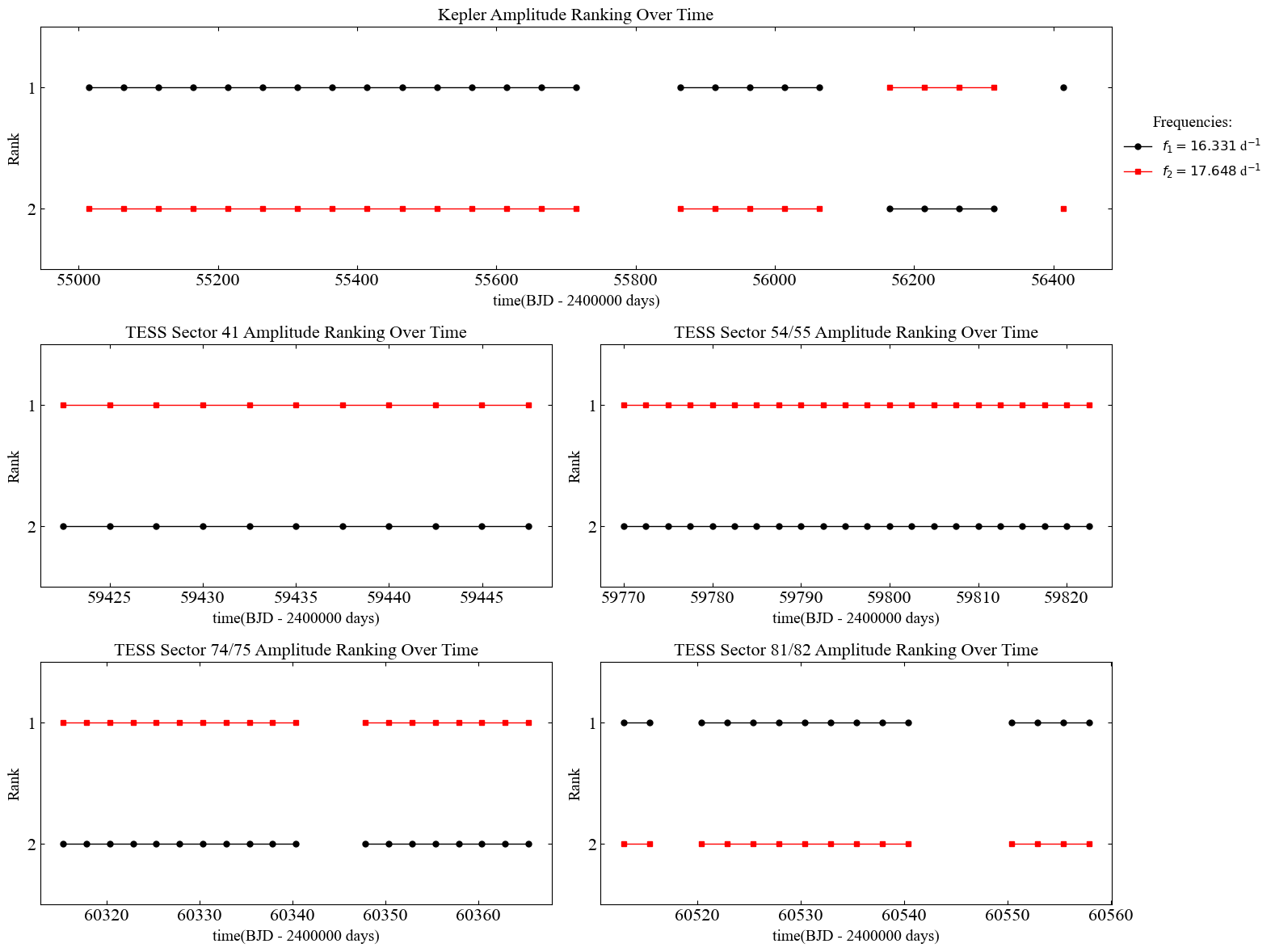
Figure 2: Evolution of amplitude ranking for the two main pulsation modes, f1 and f2, in KIC 8712760. The results indicate that f1 was the dominant frequency for most of the Kepler observation period. However, during parts of the TESS observation windows, f2 surpassed f1 to become the new dominant frequency. This suggests a possible redistribution of pulsation energy among different modes within the stellar interior.
Attachment Download:




