
Researchers Revreal Magnetic Activity in Binary Stars
A master's student at the Optical Astronomy and Technology Application Research Division of the Xinjiang Astronomical Observatory, Chinese Academy of Sciences, Zhou Jiawen, under the supervision of Pro. LIU Jinzhong, has made new progress in understanding an intriguing phenomenon in eclipsing binary stars – the O’Connell effect.
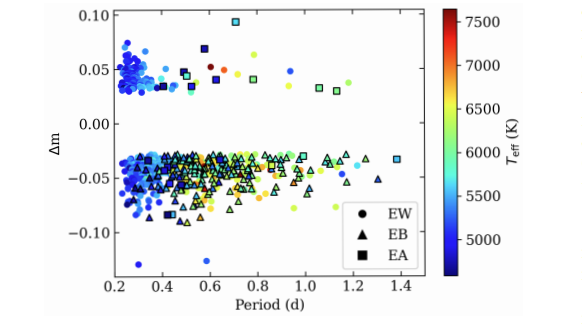
Using survey data from the ASAS-SN (All-Sky Automated Survey for Supernovae), the researchers conducted the first large-scale statistical analysis of the O’Connell effect in eclipsing binaries across the entire sky. Their findings reveal how this asymmetry is distributed among different types of binaries and how it relates to key physical parameters such as orbital period and effective temperature. The results have been published in the Astrophysical Journal Supplement Series (2026, 283, 74).
The O’Connell effect is a typical signature of magnetic activity in eclipsing binary systems. It appears as an asymmetry in the light curve around the two maximum brightness phases – meaning the two peaks of brightness during each orbit are not equal.
The researchers carefully screened a massive sample of eclipsing binaries from the ASAS-SN database, andsystematically compared the O’Connell effect in three types of binaries within a unified framework: contact binaries, semi-detached binaries, and detached binaries.
Out of 154,530 eclipsing binaries examined, 749 showed a significant O’Connell effect – about 3.6% of the total sample. Among these 749 systems, 502 are contact binaries, 217 are semi-detached, and 30 are detached. The effect is most common in systems with orbital periods between 0.2 and 0.4 days and effective temperatures between 4500 and 7500 K. In other words, the O’Connell effect tends to occur in short-period, relatively cool, close binary systems.
This large-sample study provides the first systematic picture of the O’Connell effect across the entire sky. It offers new clues about what causes this asymmetry and how it connects to binary star evolution and magnetic activity. The results also serve as a valuable reference for studying similar light-curve asymmetries using time-domain astronomy data.
The research was supported by theNational Natural Science Foundation of China and Tianshan Talents Training Program .
Attachment Download:





