
TESS Data Reveals Sustained Quasi-Periodic Oscillations in Multiple Blazars
Quasi-periodic Oscillations have been observed rarely in the active galactic nuclei and the associated period varies from a few minutes through hours, days, weeks , and even years in all observational band of the electromagnetic spectrum.
Ashutosh Tripathi from Xinjiang Astronomical Observatory, Chinese Academy of Sciences,with his collaborators, searched for the periodic signal in the Transiting Exoplanet Survey Satellite (TESS) observations of blazars in the 157-month hard X-ray survey done by Swift’s Burst Alert Telescope.
This study was published on 12th December 2025 in Monthly Notices of the Royal Astronomical Society.
In this survey. 38 objects are found to be variable. These objects are further investigated for the periodic signatures with generalized Lomb-Scargle periodogram and weighted wavelet Z-transform methods. Four objects are found to have periodicity with very high significance.
“The period of these oscillations are found to be in the range of 5-10 days for all objects. One of the objects have shown quasi-periodic signal in the observations taken 1 year apart over five years which shows that these periodic features are also present in the intervening times when there were no TESS observations. It also hints at the possibility of a QPO lasting over several years,” said Ashutosh.
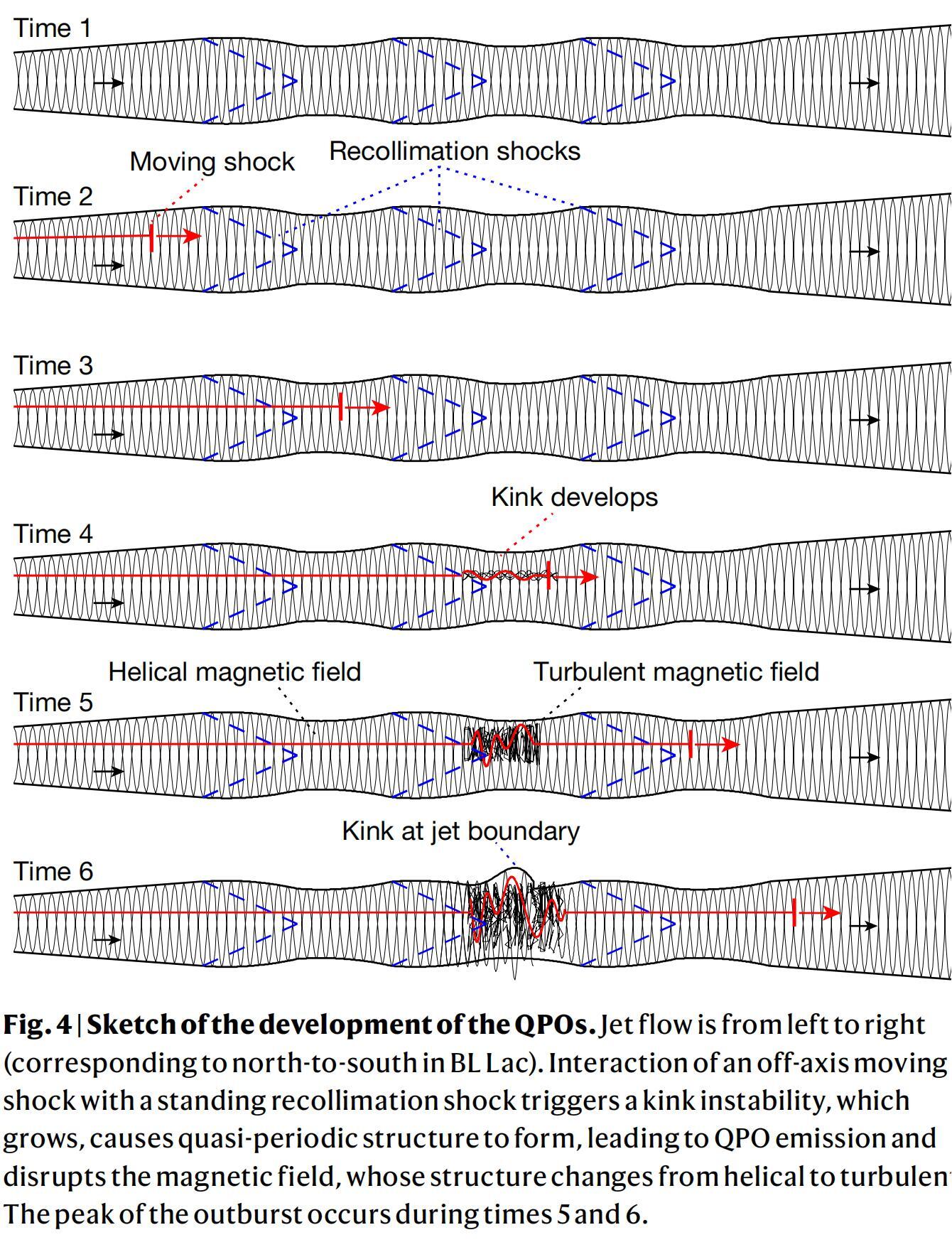
These periodicities are attributed to either the temporal evolution of a kink in the jet due to the plasma-driven instabilities or to the presence of sub-structures in the jet.
The results of such study provides more insights into the basic understanding of these compact systems and the usage of several time-series analysis methods in searching the periodic features.
Attachment Download:





