
Measuring Open Cluster Radial Velocities: Choosing the Right Stars Matters
Observational limitations mean that the radial velocities (RVs) provided by Gaia are not equally reliable for every star. TANG Tong, a PhD student at the Xinjiang Astronomical Observatory of the Chinese Academy of Sciences (CAS), together with his supervisor, Prof. ZHANG Yu, and collaborators from the Shanghai Astronomical Observatory, CAS, used Gaia Data Release 3 (DR3) to re-examine the RVs of nearby open clusters.
The average RV of cluster members indicates how fast the cluster moves toward or away from the Sun. The RV dispersion measures the spread in members' velocities along the line of sight. It is a key tracer of a cluster's internal dynamical state and is used to estimate the cluster’s dynamical mass.
After excluding RV measurements of member stars that are susceptible to observational biases, the researchers found a 26% reduction in the median RV dispersion of 171 open clusters. The median fell from 3.76 to 2.79 km/s, while the average RVs remained consistent with results from high-resolution spectroscopic surveys. The findings were published in Publications of the Astronomical Society of the Pacific.
Open clusters consist of stars born in the same giant molecular cloud and orbiting the Galactic center together. The average RV of their members indicates whether a cluster is approaching or receding from the Sun, while the RV dispersion reflects its internal dynamics.
When Gaia Radial Velocity Spectrometer (RVS) spectra are used to measure stellar RVs, spectral-line profiles and signal-to-noise ratios affect measurements across different temperatures and brightnesses. In addition, the measured RVs of unresolved binaries include a component from their orbital motion, which may inflate the measured velocity dispersion.
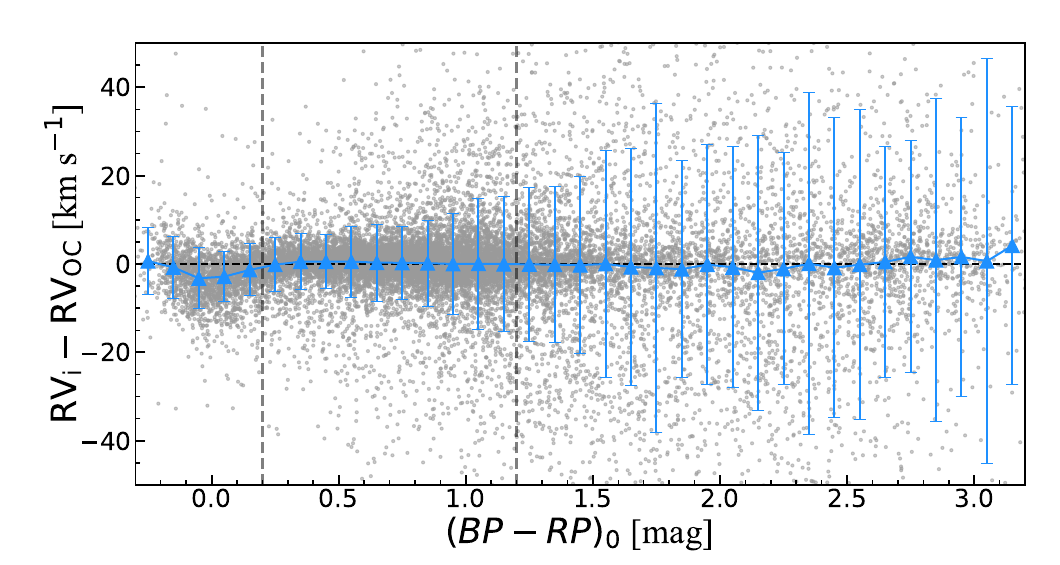
Figure 1 (Figure 2 in the paper). RV offsets of member stars relative to the median RVs of their respective clusters as a function of intrinsic color. Dashed lines mark the boundaries at (BP−RP)0 = 0.2 and 1.2 mag. Bluer stars show systematic offsets, while redder stars show markedly larger RV scatter, reflecting observational limitations affecting the spectra of different stellar types.
The researchers started with 324 clusters within 500 pc of the Sun. They applied color-based filtering to retain member stars with intrinsic colors (BP−RP)0 between 0.2 and 1.2 mag. Only clusters with sufficient numbers of these members were kept. Stars in this color range are predominantly of spectral types F, G, and K, whose spectral features are more favorable for RV measurements.
After filtering, the average cluster RVs remained broadly consistent with results from high-resolution spectroscopic studies. The RV dispersions, however, decreased markedly, with the median falling from 3.76 to 2.79 km/s.
The researchers further noted that the median RV dispersion of 2.79 km/s remained higher than the median tangential velocity dispersion of approximately 0.71 km/s. Because undetected binaries may still inflate the measured values, the filtered RV dispersions are better treated as upper limits on the clusters' internal RV dispersions.
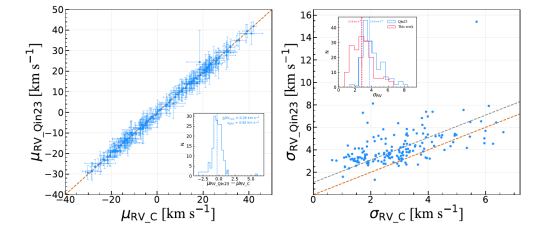
Figure 2 (Figure 3 in the paper). Average cluster RVs (left) and RV dispersions (right) after color-based filtering, compared with the catalog of Qin et al. (2023). The average RVs agree well, while the median RV dispersion decreases from 3.76 to 2.79 km/s.
They also used a total of 59 red clump giants in six of these open clusters to characterize the cluster RVs. These stars are bright and show a prominent Ca II triplet in Gaia RVS spectra, making their RVs easier to measure accurately.
The median RV uncertainty for individual stars was approximately 0.15 km/s. The cluster RV dispersions derived from these red clump giants ranged from 0.27 to 1.55 km/s. These values are comparable to the tangential velocity dispersions, which describe the spread in velocities perpendicular to the line of sight.
Despite the limited sample, the results indicate that considering stellar spectral properties and observational quality helps to obtain more reliable information on the internal motions of open clusters.
Article link: https://doi.org/10.1088/1538-3873/ae8479
Attachment Download:





