
A New Finding Reveals New Clues to Pulsar Interior–Magnetosphere Coupling
Pulsars are rapidly rotating neutron stars with exceptionally stable spin rates, making them veritable "cosmic clocks" in the universe. However, some pulsars undergo sudden "glitches"—abrupt spin-up events followed by a gradual recovery.
PSR B0919+06 is a radio pulsar with a rotation period of about 431 ms. Long-term monitoring has revealed that its spin-down rate exhibits quasi-periodic oscillations with a period of roughly 570–580 days, accompanied by changes in its pulse profile.
By analyzing the long-term timing data obtained with the Nanshan 25 m radio telescope from 2002 to 2014 and the publicly available international datasets, a research team from the Xinjiang Astronomical Observatory, Chinese Academy of Sciences, found that after experiencing a glitch around MJD 55144, the modulation period of PSR B0919+06 and its spin-down rate abruptly shortened from about 575 days to about 437 days, and then gradually recovered to about 576 days several hundred days later. This "shorten–recover" pattern is tightly correlated with the glitch, indicating that the glitch directly perturbed the physical mechanism responsible for the periodic modulation.
Through wavelet transform and autocorrelation analyses, the team verified the statistical significance of this change and ruled out artefacts due to data gaps or fitting errors. Combined with simulations, they confirmed that the glitch itself does not produce a spurious period-shortening signal. Thus, the observed variation genuinely reflects changes in the neutron star's internal state or magnetospheric environment.
They also compared other pulsars that exhibit similar quasi-periodic modulations and glitches (e.g., PSRs B1828‑11 and B0740‑28), suggesting that such phenomena may be common and providing new observational constraints on the coupling among the neutron star interior, magnetosphere, and radiation.
The results were published in The Astrophysical Journal.
This work was supported by the National Natural Science Foundation of China, the National Key R&D Program of China, the Major Science and Technology Program of Xinjiang Uygur Autonomous Region, and other funding sources.
In the future, combining these findings with high-sensitivity facilities such as FAST is expected to further reveal the deep connections between pulsar spin variations and radiative properties.
Data sources: Nanshan 25 m radio telescope and Jodrell Bank Observatory public data.
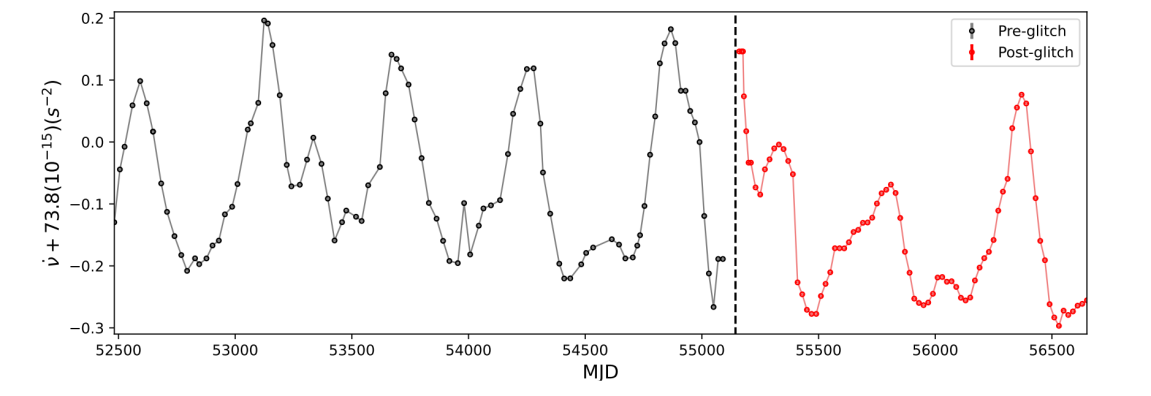
Variations of ˙ν of PSR B0919+06 by fitting ν for small sections of data.
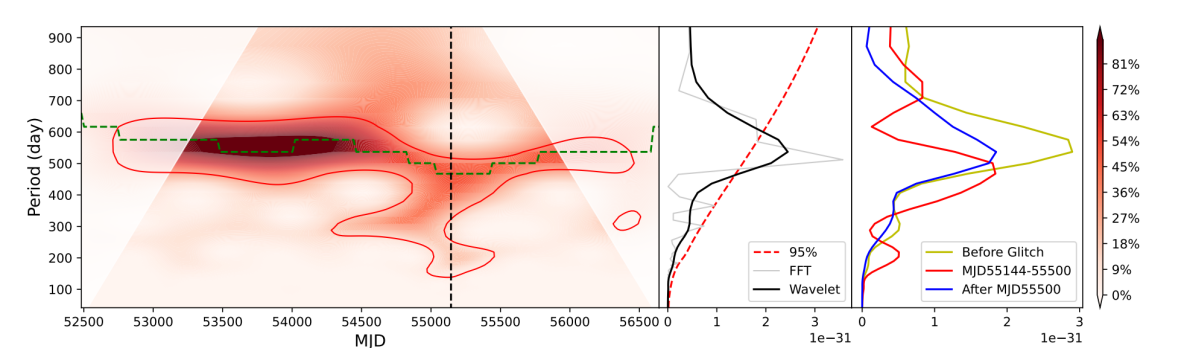
Wavelet analysis of the ˙ν variation.
Attachment Download:





