
A New Study Uncovers Unique Radiation Secrets of a Pulsar
Pulsars are rapidly spinning cosmic lighthouses, and some of them have two emission phases: an active bright state and a quiescent faint state. Signals during dormancy are extremely weak, making detailed observations difficult for a long time.
Prof.WEN Zhigang from Xinjiang Astronomical Observatory, Chinese Academy of Sciences, along with his collaborators, carried out comprehensive observational analysis of pulsar PSR B0823+26 using China’s Five-hundred-meter Aperture Spherical radio Telescope (FAST). The relevant findings have been published in The Astrophysical Journal.
Previous academic viewpoints held that the pulsar’s radio emission would completely vanish in its quiescent phase. However, high-sensitivity observations by FAST contradict this judgment. Both the main pulse and postcursor components of PSR B0823+26maintain continuous radiation throughout dormancy, with no pulse nulling observed.
The interpulse component that exists in the bright state completely disappears during dormancy. Random high-energy bright bursts only occur within the main pulse window. Besides, the main pulse exhibits stable brightness fluctuations that repeat every 20 spin periods, a feature absent in the postcursor component.
This research overturns the conventional opinion that dormancy is merely a dimmed version of the bright state. It proves that the quiescent phase has an independent magnetospheric operating mechanism, and the bright and quiescent states correspond to two entirelydistinct magnetic field and particle acceleration configurations.
The study provides critical observational evidence for unified theories of neutron star magnetospheres, and also demonstrates FAST’s unparalleled advantages in detecting faint cosmic radiation.
The researchers will conduct continuous multi-band follow-up observations to explore the fundamental physical mechanisms behind the pulsar’s state transitions.
Paper link: https://doi.org/10.3847/1538-4357/ae3d9c
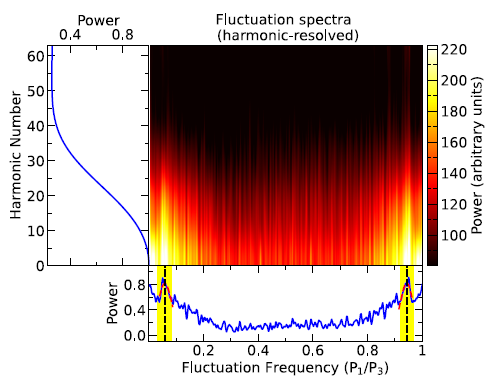
Figure Harmonic-resolved fluctuation power spectra of single pulses from pulsar PSR B0823+26 in its dormant state.
Attachment Download:





