
Peering into AI "Black Box": Interpretable Neural Networks Help Reveal the Nature of Dark Matter
HUANG Zhenyang, a master’s student at the Xinjiang Astronomical Observatory (XAO), Chinese Academy of Sciences, under the supervision of Prof. WANG Na and Senior Engineer LIU Zhiyong,developed an interpretable artificial intelligence framework named the Convolutional Kolmogorov–Arnold Network (CKAN) for studying the properties of dark matter on galaxy-cluster scales.The corresponding results have been published in the international core astronomy journal The Astronomical Journal.
The nature of dark matter is one of the most pressing open questions in contemporary astrophysics. While the cold dark matter (CDM) paradigm has been remarkably successful in explaining the large-scale structure of the Universe, it faces a number of tensions on smaller scales, such as in galaxy cluster cores. Self-interacting dark matter (SIDM) models provide a compelling alternative explanation for these small-scale discrepancies. With the rapid development of machine learning, AI has become an increasingly important tool for exploring the Universe.
In the context of cluster-scale dark matter studies, researchers at the École Polytechnique Fédérale de Lausanne (EPFL) have previously published influential work in Nature Astronomy. They demonstrated that convolutional neural networks (CNNs) can extract extremely subtle structural features from galaxy cluster simulations that include complex baryonic physics, thereby efficiently distinguishing between different dark matter models. This laid the foundation for using AI to address this long-standing physical problem.
However, the XAO researchers also recognized that, despite their impressive performance, conventional CNNs are large, black-box models whose internal decision-making is difficult to interpret, which to some extent limits further progress in this area.
To overcome this limitation, the XAO researchers introduced the CKAN framework, which is based on the Kolmogorov–Arnold representation theorem. In this network, learnable activation functions replace traditional fixed activation forms. While maintaining high classification accuracy, the internal structure of CKAN can be further cast into a symbolic representation, which substantially enhances the network’s interpretability.
Analysis of the symbolically represented network shows that the AI network spontaneously "focuses" on key physical quantities, such as the miscentering between the dark matter halo centre and the cluster centre, as well as thermal conduction features in the cluster core region. These automatically extracted features are qualitatively consistent with existing theoretical expectations and help researchers begin to understand the internal decision-making mechanisms of the neural network.
Building on this, the researchers combined network performance tests with interpretability diagnostics to obtain a quantitative inference: on galaxy cluster scales, in order for the signatures of dark matter self-interactions to be reliably identified in observations, the self-interaction cross section must be at least on the order of 0.1-0.3cm2g-1. This threshold is consistent with recent independent analyses based on galaxy cluster simulations.
Furthermore, the researchers incorporated simulated observational noise, constructed using the instrumental characteristics such as JWST and Euclid, to test the robustness of CKAN. The results indicate that CKAN retains robust model discrimination and feature identification capabilities even in the presence of those noise.
This work not only provides an efficient and interpretable new tool for studying the nature of dark matter with upcoming survey data, but also represents a valuable step toward transferring AI methods from idealized numerical simulations to real observational applications. More broadly, it offers a new perspective for using AI to extract informative features and uncover potential physical laws from astrophysical data.
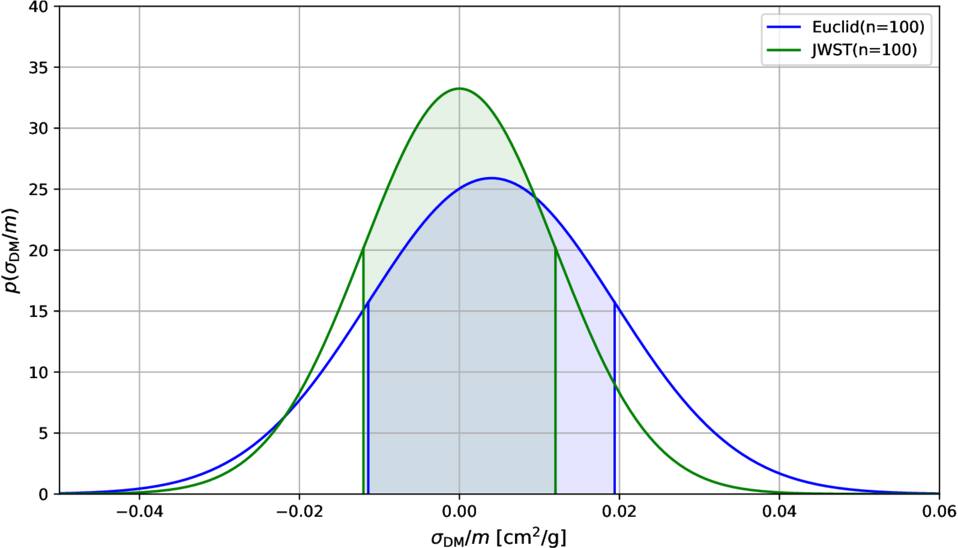
Robustness test of the CKAN under simulated observational noise. The green and blue curves represent noise levels corresponding to JWST and Euclid specifications, respectively, where n denotes the sample size. The plot displays the trained CKAN's predictions on an unseen test set of CDM-hi AGN samples (with a ground-truth cross-section of zero). The results indicate that the prediction bias for the dark matter cross-section remains minimal even in the presence of noise, demonstrating the model's strong noise resistance and potential for future observational applications.
Attachment Download:




