
2025 Seminar on Frontiers in Digital Backends and Big Data Technology for Radio Astronomy held in Urumqi
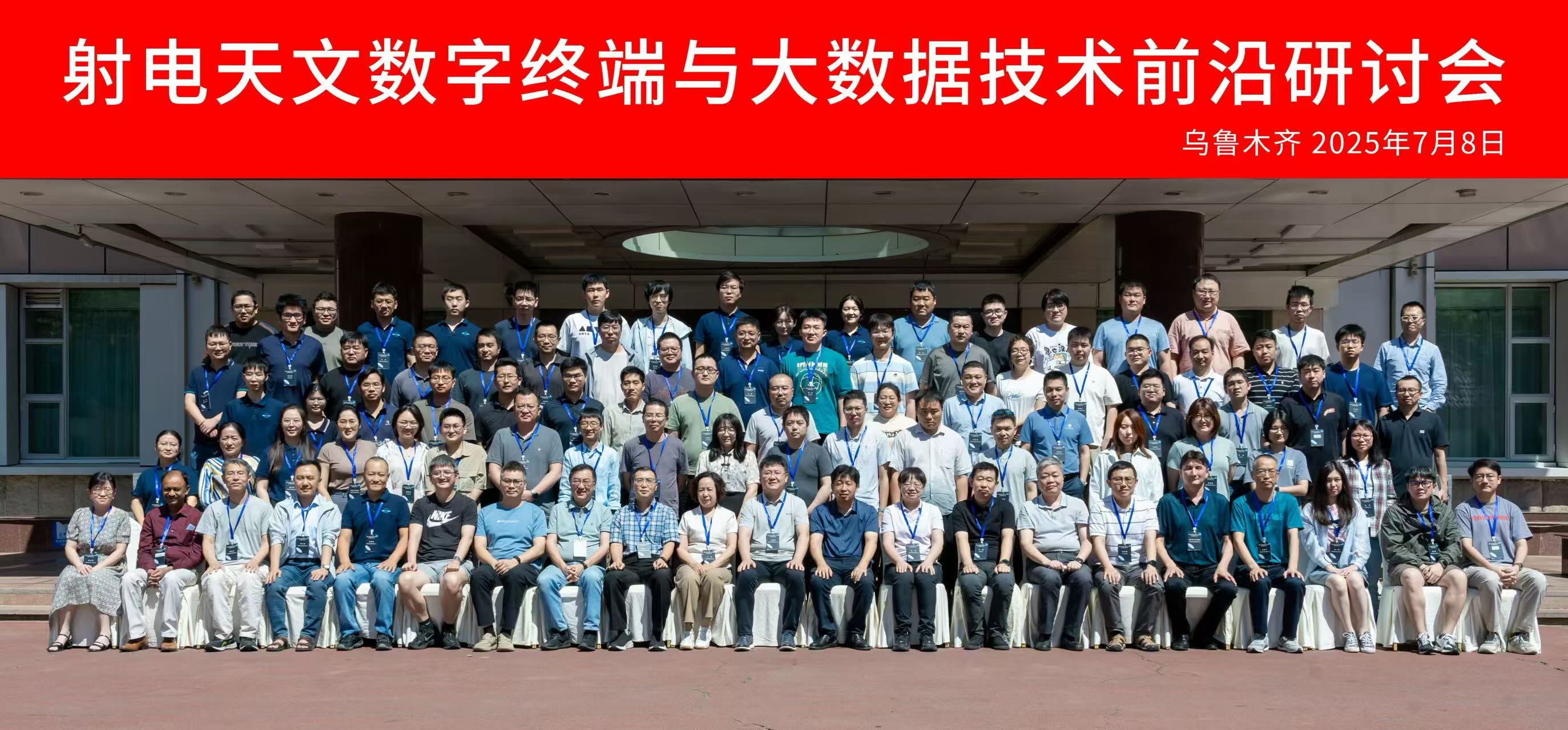
From July 8th to 10th, the "2025 Frontier Seminar on Digital Backends and Big Data Technology in Radio Astronomy" was held in Urumqi. Hosted by the Xinjiang Astronomical Observatory (XAO) of the Chinese Academy of Sciences (CAS), the opening ceremony was chaired by Prof. ZHANG Hailong, head of the Computer Technology Application Division at XAO.
Themed "Intelligent Backends Empower Astronomical Exploration, Data Drives Scientific Discovery," the seminar aimed to build a high-level academic exchange platform and promote in-depth cooperation and innovative development in the fields of radio astronomy technology and big data applications within China's astronomical community. Nearly a hundred experts and scholars from major astronomical institutions, universities, and research institutes gathered to participate in the event.
Prof. ZHOU Xia, Director of XAO; Prof. WANG Na, Chair of the seminar and Project Director of XAO; and Prof. LIU Jifeng, Director of the National Astronomical Observatories of China (NAOC) have delivered welcome speech. They all pointed out that Chinese astronomy is currently in a golden period of leapfrog development, having formed a complete innovation chain spanning from the "construction of major scientific installations - frontier basic research - astronomical application transformation - massive data processing." Facing the opportunities presented by the rapid development of artificial intelligence technology, the astronomical field should actively embrace new technologies, promote multidisciplinary integration, and help advance Chinese astronomy to world-class levels with innovative approaches.
The seminar focused on core topics such as new-generation digital backend technology, real-time signal processing, and AI applications in astronomy. Nearly 40 high-level academic reports were arranged, fully demonstrating the latest achievements from the deep integration of astronomy with information and computer sciences.
During the invited report session, four top experts delivered insightful presentations. Prof. LIU Jifeng provided an in-depth interpretation of the innovative application of AI technology in the "Skysurvey" project; NAOC Deputy Director JIANG Peng systematically introduced the technical upgrade plan for the Five-hundred-meter Aperture Spherical Radio Telescope (FAST), also dubbed as the "China Sky Eye,"; Prof.WANG Na detailed the latest progress of the QiTai radio Telescope (QTT) project; and Prof. LI Kejia from Peking University prospectively discussed the research plan for the SKA-low frequency array technology. These reports not only showcased major scientific breakthroughs of astronomical research in China, but also outlined broad prospects for future development, greatly inspiring the attendees.
During the seminar, experts and scholars visited the XAO's Qitai Station for an on-site inspection of the QTT construction site. The scholars expressed high appreciation for the engineering team's dedication and looked forward to the early commissioning of this critical national infrastructure, expecting its significant contributions to exploring the mysteries of the universe.
The participants expressed that they would take this seminar as an opportunity to further strengthen cooperation and jointly promote Chinese radio astronomy technology to the international forefront, contributing more "Chinese wisdom" to humanity's understanding of the universe.
Attachment Download:





