
About QTT
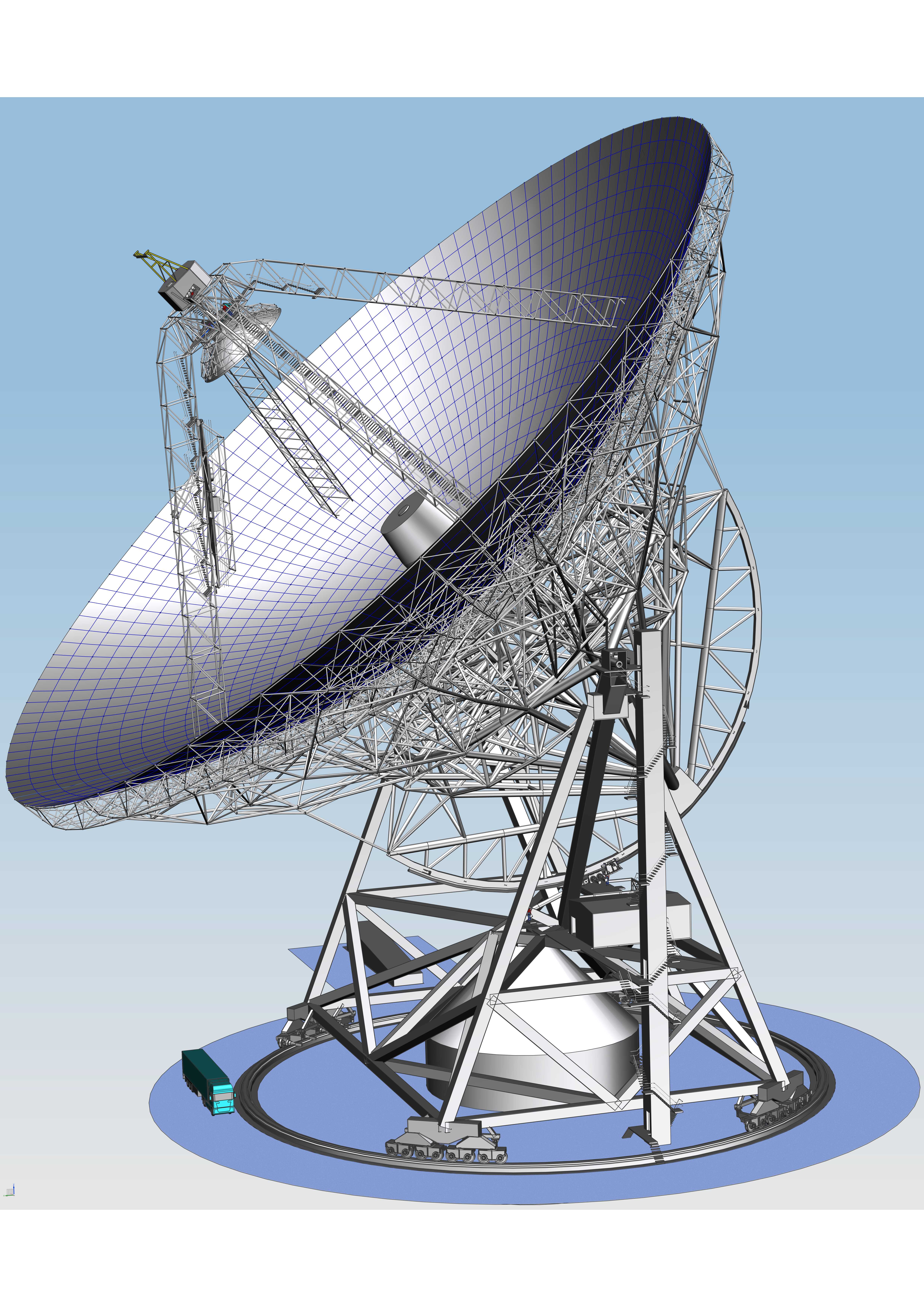
The QiTai radio Telescope (QTT) is a fully steerable, world-class radio telescope currently under construction. It is situated in Qitai County within the Xinjiang Uygur Autonomous Region of China, approximately 260 kilometers from Urumqi, at an average altitude of 1,760 meters.
Featuring a 110-meter aperture for high sensitivity observations, the QTT operates over 150 MHz to 115 GHz frequency band (wavelength from centimeter to millimeter), offering wide sky coverage and broadband observation capabilities. It can survey about three-quarters of the celestial sphere with extremely high sensitivity, while continuously covering the Galactic Center and the sky region extending 12° to its south.
The QTT will form a world-class observational platform for research in cutting-edge scientific fields, such as cosmic origins, black hole physics, gravitational wave detection, and celestial evolution.
Early scientific goals include:
1.Pulsar observations, pulsar timing array for nanoHertz gravitational wave detection.
2. Star formation and interstellar chemistry through molecular spectral lines.
3. Enhanced VLBI for high-resolution studies of active galactic nuclei and black hole physics.
4. Dark matter exploration through gravitational lensing and HI surveys.
5. Precision improvements and the connection of celestial reference frames.
6. Sky surveys for pulsars, fast radio bursts, cosmic molecules, etc.
7. Searching for extraterrestrial intelligence signals.
The QTT site:
The site is located in the heart of the Eurasian continent, within a rectangular basin surrounded by mountains at the eastern foothills of the Tianshan Mountains. The surrounding elevated ridges form a natural shielding from external interference providing an excellent radio-quiet environment. With its low wind speed and low atmospheric precipitable water vapor, the site offers weather conditions that make it exceptional for operating a large radio telescope.
Attachment Download:



